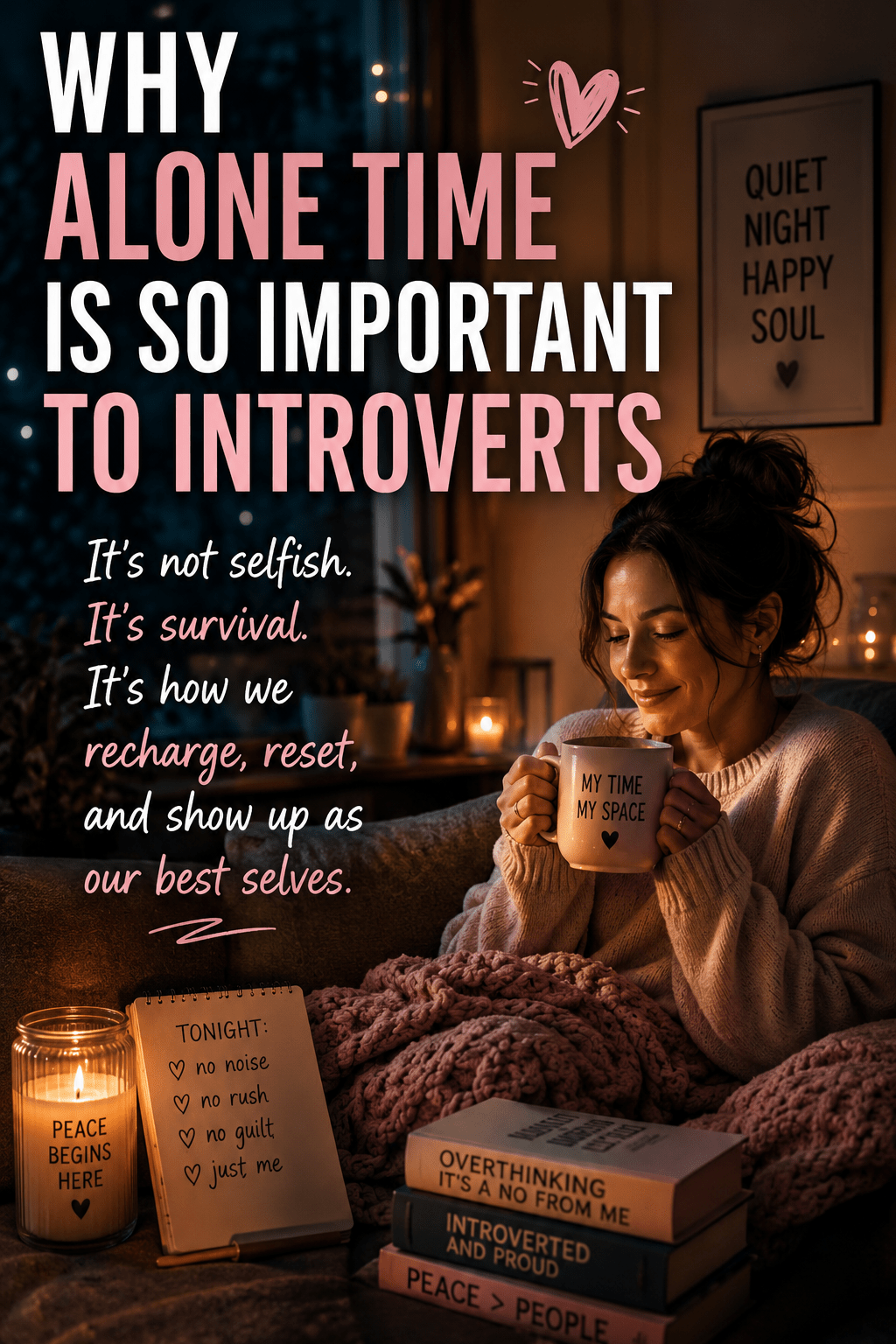
A cozy nighttime scene showing a relaxed woman wrapped in a blanket on a couch, holding a mug that says “My Time My Space.” Warm candlelight and soft lights glow around the room while large text explains why alone time is important to introverts. The peaceful setting captures the quiet comfort of late-night solitude and recharging after a long day.

Some people recharge by going out, being around friends, and staying busy all the time. Introverts are usually the exact opposite. We recharge by finally getting a little peace and quiet. Not because we hate people or don’t love our families, but because constant interaction can feel mentally exhausting after a while.

And honestly? Sometimes the best part of the day does not even start until everybody else goes to sleep.

Introverts Need Quiet To Recharge

For introverts, alone time is not some dramatic “escape from the world” thing. It is more like plugging your phone into a charger after the battery hits 5%.

When you spend all day talking, helping people, answering questions, working, parenting, cleaning, texting, and dealing with noise nonstop, your brain gets overloaded. Eventually, you just need a little silence to reset.

That reset looks different for everybody. Some people read. Some scroll TikTok in silence. Some craft, journal, watch crime documentaries, or just sit there enjoying the fact that nobody is asking them for anything for five whole minutes.

The point is simple. Alone time gives introverts breathing room.

Nighttime Feels Different

There is something magical about late-night quiet. The house feels calmer. The world slows down. No notifications going off every second. No errands. No expectations.

For a lot of introverts, nighttime becomes the only time that truly belongs to them.

I love my husband dearly, but I thank goodness he goes to bed early because I absolutely cherish that quiet nighttime window. It has always been that way for me.

Back when my kids were little, late night was literally the only alone time I could get. During the day, somebody always needed something. Snacks, homework help, rides, laundry, attention, more snacks somehow five minutes later. Moms barely get time to hear themselves think sometimes.

So I stayed up late.

Honestly, I almost never went to bed before 2 AM when my kids were younger. That was my decompression time. My brain finally got to unclench a little. I could watch what I wanted, work on my own hobbies, think my own thoughts, or just enjoy the silence without hearing “Mommmm” every twelve seconds.

Those quiet nighttime hours saved my sanity more than once.

Alone Time Does Not Mean You Love People Less

This is something introverts constantly have to explain.

Wanting alone time does not mean you are mad at your spouse. It does not mean you dislike your kids. It definitely does not mean you are antisocial.

Actually, a lot of introverts are deeply loving people. We just get emotionally drained faster from nonstop interaction.

That quiet hour at night is what helps many introverts show back up as better partners, better parents, and better humans in general.

Without that reset time, everything starts feeling overstimulating. Even little noises can become irritating when your mental battery is empty.

Meanwhile, after a little alone time? Suddenly, you feel human again.

Related: Simple Habits That Improve Mental Health

Moms Especially Understand This

Mothers, especially moms with multiple kids, know how rare true alone time can be.

Even when you technically have “free time,” somebody usually still needs something. You are still mentally on call all day long. That constant responsibility is exhausting, especially for introverts.

That is why so many moms end up becoming nighttime people.

The house finally gets quiet, and your brain immediately relaxes because nobody is touching you, asking questions, fighting over snacks, or yelling from another room.

You finally get to exist as a person instead of being needed every second.

Honestly, those little nighttime rituals become sacred after years of motherhood.

Getting Older Changes It A Little

These days, I do not stay up until 2 AM anymore. I am older now, and sleep matters a whole lot more than it used to.

But I still need that quiet nighttime decompression time.

Now I am perfectly happy squeezing in an hour or two before bed. Sometimes that is all it takes. A little silence, a little scrolling, maybe watching something nobody else in the house wants to watch, and suddenly the whole day feels balanced again.

That peaceful alone time still matters just as much as it always did.

Maybe even more.

Introverts Should Stop Feeling Guilty About Needing Space

Somewhere along the way, people started acting like wanting alone time is selfish. It is not.

Everybody has different ways of recharging emotionally. Extroverts often feel energized around people. Introverts usually recover in quiet spaces.

Neither one is wrong.

If your favorite part of the day is when the house finally gets quiet at night, you are definitely not alone. A lot of introverts understand that feeling completely.

Sometimes, the most peaceful moment of the entire day is sitting in silence while everybody else is asleep, finally getting a little time that belongs only to you.

Lisa Crow contributed to this article. She is a true crime junkie and lifestyle blogger based in Waco, Texas. Lisa is the Head of Content at Gigi’s Ramblings and Southern Bred True Crime Junkie. She spends her free time traveling when she can and making memories with her large family which consists of six children and sixteen grandchildren.


Texas country road surrounded by blooming bluebonnets and wildflowers at sunset

Hill Country Drives Bursting with Bluebonnets

If you want that classic Texas wildflower moment, the Hill Country delivers every single time. Around Fredericksburg and Llano, you’ll find rolling hills covered in bluebonnets, Indian paintbrush, and coreopsis like something out of a postcard.

The Willow City Loop is one of the best-known wildflower routes, and for good reason. During peak bloom, usually late March through mid-April, the entire drive lights up with color. That said, go early in the morning or on a weekday if you can, because folks come from all over Texas to see it.

As you cruise those backroads, slow down and take it in. You’ll pass ranch gates, creeks, and open land that feels untouched. It’s the kind of drive where you don’t need a destination, just a full tank and a little patience.

Ennis Bluebonnet Trails That Locals Swear By

Now if you want something a little more organized, head toward Ennis. This town doesn’t play around when it comes to wildflower season. Their official bluebonnet trails stretch over 40 miles, with clearly marked routes that make it easy to catch the best blooms.

The timing here usually peaks in April, and the variety is impressive. You’ll see fields packed with bluebonnets, sure, but also evening primrose and Indian blanket mixed in.

Every year, Ennis hosts the Ennis Bluebonnet Trails Festival, which brings in vendors, live music, and plenty of small-town charm. It can get busy, but honestly, that energy is part of the experience.

Coastal Prairie Blooms Near the Gulf

A lot of people forget about the Texas coast, but it quietly puts on one of the prettiest shows in the state. Around Brenham and Chappell Hill, you’ll find wildflowers stretching across open prairie with wide skies overhead.

This area tends to bloom a little earlier than the Hill Country, so it’s a good option if you’re trying to catch the season before it peaks elsewhere. Plus, the roads are flatter and easier to drive, which makes it perfect for a relaxed day trip.

And let’s be real, you’re not far from a stop at Blue Bell Creameries, which might be the best reward after a long drive.

Big Bend’s Rugged Desert Surprise

Out west, things look a little different—but that doesn’t mean less beautiful. Big Bend National Park comes alive with desert blooms when conditions are right. Think cactus flowers, ocotillo, and bright bursts of color against rough desert terrain.

The timing here depends heavily on rainfall, so it’s not as predictable. Still, when it hits, it’s something you won’t forget. Fewer crowds, wide open views, and that quiet desert feel make it worth the trip.

If you’re up for a longer drive, this route feels more like an adventure than just a scenic cruise.

Related: Texas Routes That Tourists Usually Skip

Tips for Catching Peak Wildflower Season

Timing matters more than anything. In most parts of Texas, peak bloom runs from late March through April, but weather can shift that window a bit. A warm winter usually means earlier blooms, while cooler temps can push things back.

Try to go midweek if you can, especially on popular routes. Bring water, watch for traffic when pulling over, and never step into private property just to get a picture. Those fields might look open, but a lot of them are still working land.

And one more thing—leave the flowers where they are. Texas wildflowers are part of what makes these drives special, and they stick around longer when folks respect them.

Why These Routes Never Get Old

There’s just something about a Texas spring that hits different. Maybe it’s the color after a long winter, or maybe it’s the way these drives slow you down for a bit.

Either way, these wildflower routes aren’t just about the views. They’re about taking the long way home, rolling the windows down, and remembering that sometimes the best parts of Texas aren’t the ones you plan.

Lisa Crow contributed to this article. She is a true crime junkie and lifestyle blogger based in Waco, Texas. Lisa is the Head of Content at Gigi’s Ramblings and Southern Bred True Crime Junkie. She spends her free time traveling when she can and making memories with her large family which consists of six children and sixteen grandchildren.

Colorful garden scene with baskets of fresh vegetables including tomatoes, peppers, squash, cucumbers, green beans, corn, watermelon, cantaloupe, and okra, with bold text reading “Vegetables to Plant in May for Summer Harvest” and a rustic sign that says “Plant Now. Water Well. Harvest Big.”

If you’re in Texas or anywhere with a long, hot growing season, May is go-time. The soil is warm, the sun is sticking around longer, and just about everything is ready to take off if you plant it now. So instead of overthinking it, let’s get straight into what actually thrives when you stick it in the ground this time of year.

Tomatoes That Can Handle The Heat

First up, you already know tomatoes deserve a spot in your garden. By May, you want varieties that won’t throw a fit once that summer heat rolls in. Look for heat-tolerant types like Roma, cherry, or beefsteak.

Now here’s the thing, tomatoes need full sun and consistent watering or they’ll start acting dramatic. Go ahead and mulch around the base to keep that soil from drying out too fast. Also, give them support early so you’re not wrestling vines later.

Related: DIY Gardening: Tips for Starting Your Spring Garden

Peppers That Thrive In Southern Summers

Peppers absolutely love May planting. Bell peppers, jalapeños, serranos, all of them do just fine once that heat kicks up.

While tomatoes can get a little fussy, peppers are a bit more forgiving. Still, they need sunlight and warm soil to really get moving. If your nights are staying above 60, you’re in business. Keep them watered, but don’t drown them. They like a steady routine, not a swamp.

Squash That Grows Like It Means It

Squash is one of those vegetables you plant once and then suddenly you’ve got more than you know what to do with. Zucchini and yellow squash both do great when planted in May.

Give them space, because they will spread whether you planned for it or not. Also, check them often. If you let squash sit too long, it turns into something closer to a baseball bat than dinner.

Cucumbers For Easy Summer Harvests

Cucumbers are another solid May choice. They grow fast, climb well, and produce like crazy when they’re happy.

You can let them sprawl or train them up a trellis if you want to save space. Either way works. Just make sure they get plenty of water, especially once they start flowering. Dry cucumbers turn bitter, and nobody wants that.

Green Beans That Keep Producing

Green beans are about as low-maintenance as it gets. Bush beans or pole beans, take your pick.

Plant them in May and you’ll be picking before you know it. Then, if you stay on top of harvesting, they’ll keep producing all summer. It’s one of those crops where the more you pick, the more you get.

Corn If You’ve Got The Space

Now, if you’ve got room, corn is worth it. It does best when planted in blocks instead of rows so it can pollinate properly.

Corn needs full sun, good soil, and regular watering. It’s not the most forgiving plant on this list, but when it works, it really works. Fresh corn straight off the stalk hits different.

Okra That Laughs At The Heat

If you live in the South, okra is about as reliable as it gets. It doesn’t just tolerate heat; it thrives in it.

Plant it in May and by the time summer is in full swing, it’ll be growing like it owns the place. Just keep picking it while it’s tender. Wait too long, and it turns tough quick.

Melons For A Sweet Payoff

Cantaloupe and watermelon both do well when planted in May, especially in warmer climates.

They need space, sunshine, and patience. You’re not getting instant results here, but once they start producing, it’s worth every bit of the wait. Make sure they’ve got room to spread because those vines will take over if you let them.

Related: Rooted in Spring: Gigi’s Guide to Starting Your Garden Right

A Few Quick Tips To Keep It All Growing

Now before you run out there and plant everything at once, keep a couple things in mind. First, your soil matters more than anything. If it’s dry and lifeless, your plants will struggle no matter what you put in.

Next, water deep instead of often. That helps roots grow stronger and handle the heat better. And finally, don’t overcrowd your plants. It’s tempting, but giving them space makes a huge difference once they start growing.

Wrapping It Up

May is one of the best times to get a summer garden going, especially down here where the heat sticks around. If you stick with vegetables that actually like warm soil and long days, you’re setting yourself up for a solid harvest.

So grab what you can, get it in the ground, and let that garden do its thing. Before long, you’ll be bringing in more than you expected and probably giving some away to the neighbors too.

Lisa Crow contributed to this article. She is a true crime junkie and lifestyle blogger based in Waco, Texas. Lisa is the Head of Content at Gigi’s Ramblings and Southern Bred True Crime Junkie. She spends her free time traveling when she can and making memories with her large family which consists of six children and sixteen grandchildren.

Close-up promotional image of a woman in her 40s sitting at a desk in soft natural light, looking thoughtful and calm. On the left side, bold text reads “HORMONE TESTING PANELS FOR WOMEN OVER 40” in a clean, modern layout. The background is bright and minimal with a subtle green plant for a natural, wellness-focused feel, and blood test tubes are slightly visible in the foreground.

When you hit your 40s, your body starts shifting in ways that don’t always come with a clear warning label. Energy changes, sleep gets lighter or more broken, moods can swing faster, and your cycle might start acting unpredictable. That’s usually when hormone testing stops being “optional curiosity” and starts being useful information.

Why Hormone Testing Matters At This Stage

Hormones in your 40s don’t just gently decline. They fluctuate. Estrogen, progesterone, and even testosterone can move up and down in patterns that feel random day to day.

That’s why symptoms often feel inconsistent. One week you’re fine, the next you’re exhausted, anxious, or just off. Testing helps connect those dots instead of guessing.

On top of that, thyroid changes and insulin resistance often start showing up around this age too, which can intensify everything else going on.

Core Hormones Most Panels Check

Most standard hormone panels focus on a few key hormones that give a general snapshot of what’s happening.

Estrogen (Especially Estradiol)

Estrogen affects mood, sleep, skin, and cycle regularity. In your 40s, it doesn’t just decline steadily. It can spike and drop, which is why symptoms can feel unpredictable.

Progesterone

Progesterone helps balance estrogen and supports calm, sleep, and cycle stability. When it drops, it can show up as anxiety, irritability, or restless sleep.

Testosterone

Women need testosterone too. It plays a role in energy, motivation, libido, and muscle tone. Low levels can feel like fatigue or just a general lack of drive.

Thyroid Testing Is Just As Important

A lot of people focus only on sex hormones and miss the thyroid entirely, which is a mistake.

A solid thyroid panel usually includes:

  • TSH
  • Free T3
  • Free T4
  • Thyroid antibodies (when needed)

Even small thyroid shifts can feel big. Weight changes, brain fog, hair thinning, and low energy often trace back here.

Blood Sugar And Insulin Markers

This part gets ignored too often, but it matters a lot in your 40s.

Common tests include:

  • Fasting glucose
  • Fasting insulin
  • Hemoglobin A1C

When insulin is out of balance, it can mess with energy, cravings, weight, and even hormone stability overall.

Optional But Helpful Add-On Tests

Depending on symptoms, some providers also check a few extras.

Cortisol

This is your stress hormone. When it’s off, you might feel tired but wired, or completely drained in the afternoon.

DHEA

Supports energy and hormone production. It tends to decline with age and long-term stress.

Vitamin D

Not technically a hormone, but it behaves like one in the body. Low levels can affect mood, immunity, and hormone balance.

Timing Actually Matters

Hormones shift throughout the month, so when you test can change the results.

For example, progesterone is most useful when tested about a week after ovulation. If timing is off, the numbers can look misleading even if something is actually wrong.

Related: Perimenopause Is Kicking My Ass: A Survival Story 11 Years in the Making

What These Tests Really Help You Do

Hormone testing isn’t about chasing perfect numbers. It’s about spotting patterns.

Once you see what’s high, low, or fluctuating, you can make better decisions about diet, stress, sleep, supplements, or medical treatment if needed.

Final Thought

Your 40s aren’t about everything going wrong. They’re about your body changing the rules. Hormone testing just helps you understand those new rules instead of guessing every time something feels off.

Lisa Crow contributed to this article. She is a true crime junkie and lifestyle blogger based in Waco, Texas. Lisa is the Head of Content at Gigi’s Ramblings and Southern Bred True Crime Junkie. She spends her free time traveling when she can and making memories with her large family which consists of six children and sixteen grandchildren.

Homesteader feeding chickens at sunrise while holding a basket of fresh eggs, with a cow grazing nearby, a pot cooking over an open fire, and a rustic farm scene in the background.

Early Mornings Are Non-Negotiable

Living off the land starts early, whether you like it or not. Instead of alarms, it’s usually animals, sunlight, or the simple fact that there’s too much to get done. Right away, you’re feeding livestock, checking water sources, and walking the property to make sure nothing went wrong overnight.

Because mornings set the tone, skipping tasks isn’t really an option. If you fall behind early, the rest of the day becomes harder to manage. So, even when you’re tired, you get up and handle it.

Food Takes Real Work

At first, growing your own food sounds simple. However, the reality is constant effort. You’re planting, watering, weeding, and dealing with pests on a regular basis. Then, once crops are ready, you still have to harvest and preserve them.

In addition, raising animals for food comes with its own responsibilities. Feeding, cleaning, and monitoring their health becomes part of your routine. As a result, every meal carries a deeper appreciation because you know exactly what went into it.

Maintenance Never Really Stops

Things break all the time, and that’s just part of the deal. Fences get damaged, tools wear out, and equipment doesn’t always cooperate. Because of this, a good portion of your day is spent fixing or improving something.

Over time, you naturally pick up skills. You learn how to repair what you can instead of replacing it. Otherwise, costs add up fast, and that kind of lifestyle isn’t sustainable.

Related: Forgotten Skills Grandparents Used Daily

Weather Controls Everything

No matter how well you plan, the weather has the final say. A sudden storm can wipe out a garden, while a dry stretch can slow everything down. Because of that, flexibility becomes a daily mindset.

You start paying close attention to patterns. Instead of ignoring the forecast, you plan your tasks around it. For example, you might rush to harvest before rain or hold off planting until conditions improve.

It’s Physically Demanding

There’s no way around it—living off the land is hard on your body. You’re lifting, digging, carrying, and walking constantly. Even routine tasks can take more effort than expected.

That said, your body adapts over time. While the work doesn’t get easier, you get stronger and more efficient. Still, it’s not a lifestyle for anyone expecting comfort or convenience.

Simple Living Doesn’t Mean Easy Living

A lot of people assume simple equals easy, but that’s not how it works. Instead of trading time for money, you’re trading time for survival and independence. While that can be fulfilling, it also means there’s always something that needs attention.

Even downtime feels different. You might be resting, but you’re also thinking about the next task, the next repair, or the next season.

Why People Still Choose It

Despite the challenges, many people stick with it. There’s a sense of control and connection that’s hard to find elsewhere. You know where your food comes from, you rely on your own effort, and you build something real over time.

More importantly, it creates a different kind of satisfaction. It’s not about convenience—it’s about purpose. And for some, that trade-off is absolutely worth it.

Lisa Crow contributed to this article. She is a true crime junkie and lifestyle blogger based in Waco, Texas. Lisa is the Head of Content at Gigi’s Ramblings and Southern Bred True Crime Junkie. She spends her free time traveling when she can and making memories with her large family which consists of six children and sixteen grandchildren.

“A cozy, real-life comfort scene inside a warm home. A soft throw blanket draped over a couch, a lit wax melt burner on a side table, a warm glowing lamp, and a relaxed, lived-in feel. A phone resting nearby, a simple snack like grilled cheese or a bowl of soup on a tray, and soft neutral tones throughout the room. The atmosphere feels calm, comforting, and real, not staged or perfect. Natural lighting, slightly moody but warm, inviting and peaceful.”

Some days just hit different. You’re tired, overstimulated, or just not in the mood for anything complicated. That’s where simple, real-life comfort comes in. Not expensive, not time-consuming, just things that genuinely make you feel a little better.

Create a Cozy Corner You Actually Use

You don’t need a whole Pinterest-worthy setup. Just claim a spot in your house that feels good to you.

It could be your favorite chair, a corner of the couch, or even your bed piled up with soft blankets. Add a throw, a dim lamp, and maybe your favorite wax melts going. Suddenly, you’ve got a place your brain associates with slowing down.

The key is making it easy. If it’s too much effort, you won’t use it.

Put Something Familiar On in the Background

Comfort doesn’t always mean silence. Sometimes it’s the opposite.

Turn on a show you’ve seen a hundred times, a movie you love, or even a podcast that feels like company. There’s something about familiar voices that takes the edge off a long day.

You don’t have to sit and watch. Let it play while you fold laundry, scroll your phone, or just sit there doing nothing.

Related: How Clutter Affects Thinking (And Why It’s Draining You More Than You Realize)

Take a Shower That Feels Like a Reset

Not a rushed, get-in-get-out kind of shower. A real one.

Let the water run hot, stay in longer than usual, and actually relax your shoulders for once. Use your favorite scents and just let the day rinse off.

It sounds simple, but it works every single time.

Cook Something Easy and Comforting

You don’t need a full spread. In fact, simple is better.

Make something warm and familiar. Think grilled cheese, a bowl of soup, or even just heating up leftovers that hit the spot. The goal isn’t to impress anyone, it’s to feel taken care of.

Bonus points if you sit down and actually enjoy it instead of eating on the go.

Step Outside for a Few Minutes

Even if you don’t feel like it.

Fresh air has a way of breaking up whatever funk you’re in. Sit on the porch, walk to the mailbox, or just stand outside for a minute and breathe.

You don’t need a full workout or a long walk. A small reset is still a reset.

Wrap Up in Something Soft

There’s a reason people reach for blankets when they’re stressed.

A soft hoodie, fuzzy socks, or your favorite blanket can instantly make you feel more grounded. It’s a small thing, but your body notices.

Comfort is physical too, not just mental.

Do One Tiny Thing That Feels Productive

When everything feels off, doing one small task can help more than you think.

Make the bed. Clear off a table. Start a load of laundry.

You’re not trying to fix your whole life in one afternoon. You’re just giving yourself a small win.

Let Yourself Be Quiet

Not every moment needs to be filled.

Sometimes comfort looks like sitting in a quiet room, no noise, no expectations, just being still for a bit. It might feel weird at first, but it gives your mind a chance to catch up.

Reach Out to Someone You Trust

You don’t have to carry everything by yourself.

Send a quick text, make a short call, or even just check in with someone who gets you. You don’t need a deep conversation. Sometimes a simple “hey” is enough to feel a little less alone.

Give Yourself Permission to Do Less

This one matters more than anything else.

Not every day is meant to be productive or perfect. Some days are just about getting through and taking care of yourself the best you can.

And honestly, that’s more than enough.

Real comfort isn’t complicated. It’s those small, familiar things that help you breathe a little easier and feel a little more like yourself again.

Lisa Crow contributed to this article. She is a true crime junkie and lifestyle blogger based in Waco, Texas. Lisa is the Head of Content at Gigi’s Ramblings and Southern Bred True Crime Junkie. She spends her free time traveling when she can and making memories with her large family which consists of six children and sixteen grandchildren.

Infographic titled “Why People Seek Validation” featuring a thoughtful woman with a social media notification icon. The design explains key reasons people seek approval, including human nature, childhood conditioning, social media influence, fear of rejection, and habit formation. A second section outlines how to break the cycle with steps like noticing approval-seeking behavior, making independent decisions, limiting comparison, accepting disagreement, and building self-worth. The layout uses soft colors, icons, and clear sections to present the information in a friendly, easy-to-read style.

At some point, everyone looks for approval. It might show up as checking likes on a post, asking for opinions before making a decision, or needing reassurance that you’re doing things “right.” On the surface, it seems harmless. However, when validation becomes a constant need, it can quietly shape how you think, act, and even see yourself.

So why does it happen in the first place?

It Starts With Human Nature

Humans are wired for connection. Back in the day, being accepted by a group meant survival. Because of that, your brain still treats approval as something valuable. When someone agrees with you or praises you, it triggers a small reward response. As a result, you feel good and want more of it.

Because of this natural wiring, seeking validation isn’t a flaw. It’s just part of being human.

Childhood Conditioning Plays a Role

For many people, the need for validation starts early. If you were praised only when you achieved something or behaved a certain way, you may have learned that approval equals worth.

Over time, this creates a pattern. Instead of feeling confident on your own, you begin to rely on others to confirm your value. Even in adulthood, that old conditioning can stick around.

Social Media Makes It Worse

Today, validation is everywhere. Every like, comment, and share becomes a quick measure of approval. Because of that, it’s easy to tie your self-worth to numbers on a screen.

Even worse, social platforms often highlight the best parts of other people’s lives. This can lead to constant comparison. As a result, you may feel like you’re falling short and look for validation to fill that gap.

Fear of Rejection Drives It

Another big factor is fear. Nobody likes being rejected or judged. Seeking validation can feel like a way to avoid that discomfort.

For example, you might hold back your opinion until you know others agree. Or you may second-guess decisions just to make sure they’re “acceptable.” While this might feel safe in the moment, it slowly chips away at your confidence.

Related: How to Spot the Signs of a Narcissist

It Becomes a Habit

The more you rely on validation, the more automatic it becomes. Instead of trusting yourself, you start outsourcing your decisions.

Over time, this can lead to:

  • Constant self-doubt
  • Difficulty making choices
  • Feeling anxious without reassurance

Because of this cycle, validation stops being helpful and starts becoming limiting.

The Hidden Cost of Seeking Validation

At first, validation feels good. However, it often comes with a price.

You may begin to:

  • Change who you are to fit expectations
  • Avoid risks to stay “approved”
  • Depend on others for your sense of worth

As a result, you lose touch with your own voice. Instead of living authentically, you start living for approval.

How to Break the Cycle

The good news is you can shift away from needing constant validation. It just takes awareness and small changes.

First, start noticing when you seek approval. Are you asking for opinions out of curiosity or insecurity? That awareness alone can help you pause.

Next, practice making small decisions on your own. Over time, this builds trust in yourself.

Also, limit comparison. What you see online isn’t the full picture, so it’s not a fair standard to measure yourself against.

Finally, remind yourself that not everyone will agree with you. And that’s okay. Disagreement doesn’t mean you’re wrong or unworthy.

Final Thoughts

Seeking validation is normal, but relying on it too much can hold you back. When you begin to trust your own judgment, things start to shift.

Instead of chasing approval, you start building confidence from within. And that kind of confidence doesn’t depend on anyone else.

Lisa Crow contributed to this article. She is a true crime junkie and lifestyle blogger based in Waco, Texas. Lisa is the Head of Content at Gigi’s Ramblings and Southern Bred True Crime Junkie. She spends her free time traveling when she can and making memories with her large family which consists of six children and sixteen grandchildren.
A frustrated man sits on the floor in the middle of a messy DIY furniture assembly project, holding printed instructions in one hand and facepalming with the other. Around him are scattered screws, tools, and partially assembled furniture pieces. A yellow power drill rests nearby, and a coffee mug sits on the floor. Large bold text on the left side reads: “DIY ALWAYS LOOKS EASIER THAN IT TURNS OUT,” emphasizing the contrast between expectation and reality.

That “How Hard Can It Be” Moment

You know how it goes. You’re scrolling and somebody online knocks out a “simple” DIY project in no time, everything looking clean and effortless. No stress, no mess, just smooth progress from start to finish.

So naturally, you think you can do it too.

Then reality shows up and reminds you it’s been waiting on you the whole time.

What they don’t show is the mess in between. The wrong measurements, the extra trips to the store, and that quiet moment where you’re just standing there holding a tool wondering how it all went sideways.

The Hidden Steps Nobody Mentions

Most DIY projects aren’t hard because they’re complex. They’re hard because nobody talks about all the little steps in between.

Painting a room sounds easy until you realize you’ve got to move furniture, patch holes, sand spots, tape everything off, prime, and then paint—probably twice. And somehow there’s still a drip right in the worst possible place.

Same thing with furniture builds or home fixes. Anything labeled “quick” usually isn’t.

Tools Make More Difference Than People Admit

A lot of “easy DIY” confidence comes from people already having the right tools. The rest of us are out here improvising like it’s a survival show.

A decent drill, the right bit, and actual instructions that make sense can change everything. Without those, even simple jobs turn into a slow spiral of frustration.

And instructions? Half the time they read like they were translated through three languages and written by someone who’s never seen your actual problem.

Time Is Always the Real Trick

Nobody really tells you how long things take. A “30-minute project” has a way of swallowing your entire afternoon without warning.

Not because you’re doing it wrong, but because real life keeps interrupting. You drop a screw, you can’t find a stud, something doesn’t fit, or you just take a short break that somehow eats an hour.

DIY doesn’t respect your schedule at all.

The Mess Comes With It

Online, everything looks clean and organized. In real life, DIY looks like controlled chaos spread across your entire space.

There’s packaging everywhere, tools you swore you just had in your hand, and that growing pile of “I’ll clean it up later” that keeps getting ignored.

That’s just part of it, even if nobody posts that version.

When It Actually Comes Together

Funny thing is, when it finally does work out, it feels good. Not perfect-good. More like “I wrestled this thing into place and won” good.

It might be a little crooked or take way longer than planned, but it’s yours. You figured it out as you went, and that counts for something.

Bottom Line

DIY looks easy because you’re only seeing the finished version. The real process has mistakes, delays, confusion, and a whole lot of figuring it out on the fly.

But that’s how it actually works. Not easy, just doable—if you stick with it.

Lisa Crow contributed to this article. She is a true crime junkie and lifestyle blogger based in Waco, Texas. Lisa is the Head of Content at Gigi’s Ramblings and Southern Bred True Crime Junkie. She spends her free time traveling when she can and making memories with her large family which consists of six children and sixteen grandchildren.

Infographic comparing motivation and discipline showing mood-driven motivation with inconsistent results versus decision-driven discipline with consistent long-term success

Why Motivation Always Fades

Motivation feels powerful in the moment. It gives you that initial push, the excitement of a new goal, and the belief that this time will be different. However, motivation is emotional, and emotions are unreliable. Some days you wake up ready to conquer everything, while other days even simple tasks feel overwhelming.

Because of this, motivation alone cannot sustain long-term progress. It comes and goes based on your mood, energy, environment, and even stress levels. As a result, relying on motivation is like trying to build a house on shifting sand. Eventually, everything collapses when the feeling disappears.

Understanding What Discipline Really Is

Discipline is often misunderstood as punishment or restriction. In reality, discipline is structure. It is the ability to take action regardless of how you feel in the moment. Instead of waiting for the perfect mood, disciplined people follow through because they have decided to.

Moreover, discipline removes the need to negotiate with yourself. You do not ask, “Do I feel like doing this today?” You simply do it because it aligns with your goals. Over time, this consistency builds trust in yourself, which is far more valuable than temporary bursts of motivation.

The Key Difference Between Motivation and Discipline

Motivation is based on feelings, while discipline is based on decisions. This distinction matters more than most people realize. When you depend on feelings, your actions become inconsistent. On the other hand, when you depend on decisions, your actions become predictable and reliable.

For example, someone motivated to exercise might go to the gym for a week and then stop. In contrast, someone disciplined shows up whether they feel energized or exhausted. Because of this, discipline produces results while motivation only sparks beginnings.

Related: How Clutter Affects Thinking (And Why It’s Draining You More Than You Realize)

How to Make the Shift

The transition from motivation to discipline does not happen overnight. It requires a change in mindset and daily habits. First, you need to stop chasing the feeling of being motivated. Instead, focus on building routines that remove decision-making.

Next, simplify your goals. When tasks feel too big, it becomes easy to avoid them. However, breaking them into smaller, manageable steps makes consistency easier. For instance, committing to ten minutes of work is far more sustainable than waiting for the perfect hour of focus.

In addition, create non-negotiable habits. These are actions you complete no matter what. Whether it is writing, exercising, or working on your business, the goal is to make these tasks automatic rather than optional.

Building Systems That Support Discipline

Discipline thrives in the right environment. Therefore, setting up systems is essential. Start by removing distractions that make it easier to quit. Then, organize your space in a way that encourages action.

At the same time, use triggers to build habits. For example, doing a task immediately after another daily activity helps create consistency. This approach reduces the mental effort required to get started.

Furthermore, tracking progress can reinforce discipline. When you see evidence of your consistency, it becomes easier to keep going. Even small wins add up over time and create momentum.

What Happens When You Rely on Discipline

Once discipline becomes your foundation, everything changes. You no longer depend on fleeting bursts of energy to move forward. Instead, progress becomes steady and predictable.

As a result, you build confidence in your ability to follow through. This confidence leads to bigger goals and greater achievements. More importantly, you develop resilience. When challenges arise, you continue moving forward instead of stopping.

The Long-Term Payoff

Although motivation feels exciting, discipline is what creates lasting success. It allows you to show up on the days when nothing feels right. Over time, those ordinary, consistent actions lead to extraordinary results.

Ultimately, the shift from motivation to discipline is about control. You stop being controlled by your feelings and start being guided by your decisions. That is where real progress begins and where lasting change is built.

Lisa Crow contributed to this article. She is a true crime junkie and lifestyle blogger based in Waco, Texas. Lisa is the Head of Content at Gigi’s Ramblings and Southern Bred True Crime Junkie. She spends her free time traveling when she can and making memories with her large family which consists of six children and sixteen grandchildren.

A cluttered room transforming into a clean, organized space to represent improved focus and mental clarity

The Hidden Mental Cost of Clutter

Clutter might seem like nothing more than a physical issue, something you can ignore until you feel like cleaning, but it goes much deeper than that. When your environment is filled with too many objects, your brain is constantly taking in and processing everything around you, whether you realize it or not. Every pile, every misplaced item, and every crowded surface adds to the mental load your brain is already carrying. Over time, this creates a kind of background noise that makes it harder to focus, harder to relax, and harder to think clearly.

Why Your Brain Hates Mess

Your brain naturally looks for order and structure because it helps you function efficiently. When your surroundings are chaotic, your brain has to work harder to filter out what matters and what does not. This connects directly to Cognitive Load Theory, which explains that your brain has a limited capacity for processing information at any given time. When clutter fills your space, it also fills that capacity, leaving less room for important thoughts, decisions, and problem-solving. That is why even simple tasks can start to feel overwhelming when your environment is messy.

Clutter Slows Down Your Thinking

A cluttered space creates constant distractions that interrupt your ability to concentrate. Instead of moving smoothly from one task to another, your brain is forced to pause and process unnecessary information. This slows you down, increases the chances of mistakes, and makes it harder to stay on track. What should be quick and simple tasks often take longer than they should, and that added friction builds frustration throughout the day. Over time, this can make you feel mentally exhausted without any clear reason why.

Related: Clean All Year: My Routine for a Tidy Home

The Link Between Clutter and Stress

Clutter does not just affect your focus; it also affects how your body responds to your environment. When things feel out of control visually, your brain interprets that as a problem that needs attention. This can trigger a low-level stress response that stays active longer than it should. That response is tied to the Fight-or-Flight Response, which is meant to help you react to danger but can also be activated by ongoing environmental stress. Even if you are not consciously worried about the mess, your body still reacts to it, which slowly drains your energy.

Decision Fatigue Gets Worse

Clutter also increases the number of small decisions you have to make throughout the day. When your space is disorganized, you are constantly asking yourself where things are, whether you need them, and when you should deal with them. These repeated decisions may seem minor, but they add up quickly and contribute to Decision Fatigue. As your mental energy gets used up, your ability to make good decisions decreases, which is why everything starts to feel harder by the end of the day.

Why Clean Spaces Feel So Good

When your space is clean and organized, your brain no longer has to filter through unnecessary distractions. Instead, it can focus fully on what matters. A clean environment signals that there are no unfinished tasks competing for your attention, which creates a sense of control and calm. This is why cleaning often brings an immediate feeling of relief, because it reduces mental strain and frees up energy for more important things like creativity, focus, and problem-solving.

Related: How I Clean When I’m Mad

Small Changes That Make a Big Difference

Improving your space does not require a complete overhaul. Small, consistent changes can have a significant impact on how you think and feel. Taking a few minutes each day to reset your environment, clearing off surfaces, and giving everyday items a designated place can reduce the mental clutter that builds up over time. The goal is not perfection but creating a space that supports clear thinking instead of working against it.

The Bottom Line

Clutter is more than just a visual issue; it is a mental one. It quietly interferes with your ability to focus, increases your stress levels, and drains your energy in ways that are easy to overlook. By taking control of your environment, you are also taking control of your mental clarity. When your space is clear, your mind has the freedom to function the way it was meant to.

Lisa Crow contributed to this article. She is a true crime junkie and lifestyle blogger based in Waco, Texas. Lisa is the Head of Content at Gigi’s Ramblings and Southern Bred True Crime Junkie. She spends her free time traveling when she can and making memories with her large family which consists of six children and sixteen grandchildren.