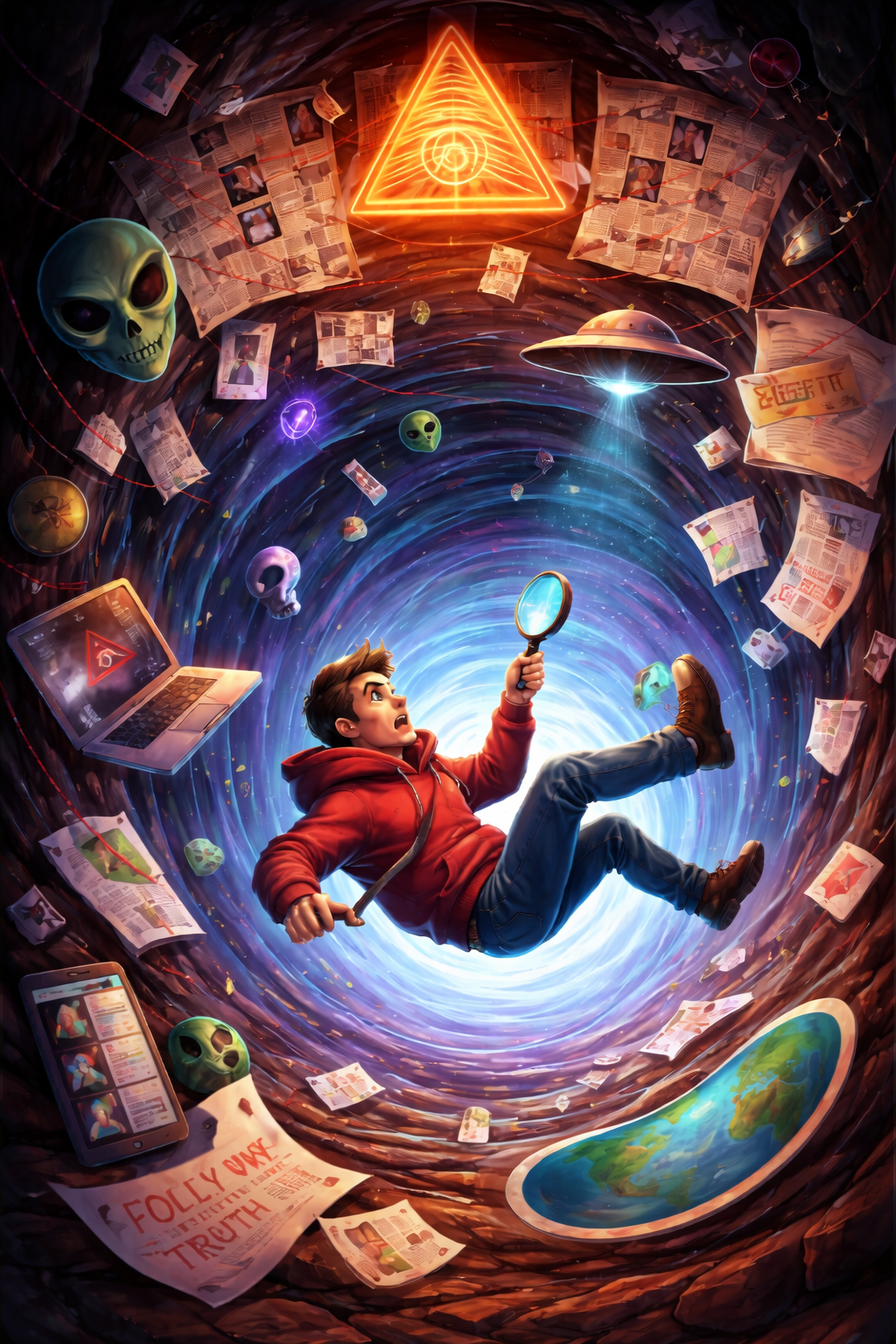
Teen boy in a red hoodie falls through a swirling vortex of conspiracy symbols, including UFOs, alien heads, scattered documents, and a glowing triangle, as he examines clues with a magnifying glass

Why We Get Pulled In So Easily

There’s something oddly satisfying about feeling like you’ve uncovered something hidden. That’s exactly where conspiracy rabbit holes get their grip. At the core of it all is curiosity, but not the casual kind. This is the kind that whispers what if there’s more to the story?

As people scroll late at night or click just one more video, the brain starts rewarding that behavior. Dopamine kicks in every time a “new clue” shows up. It feels like progress, like solving a mystery. However, instead of reaching a clear answer, the path keeps stretching further. That’s what turns a simple question into a full-blown rabbit hole.

At the same time, people are wired to look for patterns. Even when none exist, the brain tries to connect dots. So when unrelated events pop up, it becomes tempting to tie them together into one big explanation. That explanation may not be accurate, but it feels meaningful, and that feeling is hard to shake.

The Need for Control in a Chaotic World

Life does not always make sense. Bad things happen, and sometimes there is no clear reason why. That lack of control can sit heavily, so the brain looks for ways to fix that feeling.

This is where conspiracy thinking steps in. Instead of randomness, there is suddenly a plan. Instead of chaos, there is intention. Even if that intention feels dark or unsettling, it still feels better than believing everything is completely out of control.

Because of that, conspiracy rabbit holes tend to grow during uncertain times. When the world feels shaky, people start searching harder for answers. The problem is, the deeper someone goes, the harder it becomes to separate what is real from what just feels convincing.

Confirmation Bias Keeps the Cycle Going

Once someone leans toward believing something, the brain starts filtering information. This is called confirmation bias, and it plays a huge role in how rabbit holes deepen.

Instead of looking at all sides, people begin to favor anything that supports what they already believe. Videos, articles, comments, and even random posts start to line up in a way that reinforces the idea. On the flip side, anything that challenges it gets ignored or dismissed.

Over time, this creates a loop. The more someone believes, the more they see “evidence.” The more evidence they see, the stronger the belief becomes. It feeds itself, and breaking out of that loop gets harder the longer it goes on.

The Internet Makes It Way Too Easy

Years ago, you had to actually go looking for fringe ideas. Now they find you. Algorithms are built to keep people engaged, so once someone shows interest in a topic, more of it gets pushed their way.

Watch one video, and suddenly there are ten more lined up. Click on an article, and your feed fills with similar content. Before long, it feels like everyone is talking about the same thing, even if it is just a curated bubble.

This constant exposure creates the illusion that the idea is more widely accepted than it really is. It also speeds up how quickly someone can fall deeper into a rabbit hole without even realizing it.

The Social Connection Factor

One thing people do not talk about enough is how conspiracy communities can feel welcoming. When someone finds others who believe the same thing, there is a sense of belonging that can be hard to walk away from.

Conversations feel validating. Ideas get reinforced. People start to feel like they are part of something bigger, like they are among the few who “see the truth.”

Walking away from that is not just about changing your mind. It can feel like losing a community. That emotional connection is one of the biggest reasons people stay locked into those beliefs longer than they probably would otherwise.

Related:The Psychology Behind Crimes of Passion

Why It Is So Hard to Climb Back Out

Getting pulled into a conspiracy rabbit hole is one thing. Climbing back out is something else entirely.

The deeper someone goes, the more time and energy they have invested. Admitting something might not be true can feel like admitting they were wrong the whole time, and nobody enjoys that feeling.

On top of that, leaving the belief often means stepping away from the community that came with it. That double hit makes it easier to stay in the rabbit hole than to question it.

In the end, it is not about intelligence or gullibility. It is about human psychology. Curiosity, fear, the need for control, and the desire to belong all play a part. Put all of that together, and it becomes a lot easier to understand why so many people get pulled in and why so many struggle to get back out.

Lisa Crow contributed to this article. She is a true crime junkie and lifestyle blogger based in Waco, Texas. Lisa is the Head of Content at Gigi’s Ramblings and Southern Bred True Crime Junkie. She spends her free time traveling when she can and making memories with her large family which consists of six children and sixteen grandchildren.
thanksgiving crime scene

Thanksgiving is meant to be a time for gratitude, family, and good food—but for some, it’s a day that turned dark and unforgettable. Over the years, several shocking crimes have unfolded on this holiday, proving that even the most peaceful traditions can take a deadly turn. Let’s look at a few Thanksgiving tragedies that shook their communities to the core.

The Thanksgiving Day Massacre – Jupiter, Florida (2009)

What was supposed to be a joyful family dinner turned into a horrific scene when 35-year-old Paul Michael Merhige opened fire on his own relatives during Thanksgiving dinner. He killed four family members, including his 6-year-old cousin Makayla. Merhige had reportedly harbored long-standing resentment toward his family, and the attack was carefully planned. He fled the scene and was captured weeks later after being featured on America’s Most Wanted.

The Thanksgiving Slasher – New York City (2016)

On Thanksgiving Day 2016, police were called to a Manhattan apartment where 23-year-old Halima Aden was found stabbed to death. Her boyfriend, Rasheem Brown, was later arrested and charged with her murder. Investigators revealed that an argument over dinner preparations escalated into violence. The case served as a grim reminder that domestic disputes can turn deadly—even on a day meant for love and togetherness.

The Hidden Horror of the Bradford Family (Texas, 2012)

In 2012, in rural Texas, police discovered the bodies of 48-year-old Timothy Bradford and his wife, Debra, after neighbors grew concerned when they didn’t show up for Thanksgiving dinner. Their son, 22-year-old William Bradford, later confessed to killing both parents the night before. He calmly joined friends for a Thanksgiving meal the next day as though nothing had happened. When police confronted him days later, he admitted to the murders without remorse.

The Turkey Day Tragedy – Sacramento, California (2013)

Thanksgiving morning in 2013, neighbors heard gunfire coming from a quiet home in Sacramento. When officers arrived, they found a family of four dead inside. Investigators learned that 28-year-old Andres Avila shot his wife and two children before turning the gun on himself. Family members said the couple had been struggling financially and emotionally. The case became known locally as the “Turkey Day Tragedy.”

The Murder of Heather Bogle – Ohio (2015)

While Heather’s murder wasn’t discovered until days later, investigators believe she was killed over Thanksgiving weekend. The 28-year-old mother was last seen leaving work the day after the holiday. Her body was found beaten and shot, stuffed inside the trunk of her car. The case took several years to solve, with multiple false arrests along the way. Eventually, Daniel Myers, her former coworker, was convicted. The case exposed corruption and incompetence within local law enforcement and sparked community outrage.

Thanksgiving Gone Wrong – Maine (2018)

In 2018, 47-year-old Patrick McCabe was arrested after stabbing his brother during a Thanksgiving dinner in Maine. The fight reportedly started over politics and quickly escalated. The brother survived, but the story went viral as a symbol of how volatile family gatherings can become when tempers flare.

A Day for Family—and for Murder

These stories remind us that beneath the warmth of the holiday season, tensions, secrets, and resentment can sometimes boil over. Thanksgiving may be about gratitude, but for the families of these victims, the day will forever be marked by loss.

Lisa Crow contributed to this article. She is a true crime junkie and lifestyle blogger based in Waco, Texas. Lisa is the Head of Content at Gigi’s Ramblings and Southern Bred True Crime Junkie. She spends her free time traveling when she can and making memories with her large family which consists of six children and fifteen grandchildren.

Halloween crime scene

It’s spooky season here on Gigi’s Ramblings, and this year, we’re diving into stories that send a chill down your spine for more than one reason. While some folks decorate with ghosts and goblins, others face real-life hauntings — the kind that come from unanswered questions and unsolved crimes. These famous Halloween cold cases still haunt the families who live with the echoes every October.

The Disappearance of Hyun Jong “Cindy” Song (2001)

In 2001, Penn State student Cindy Song vanished after a Halloween party. She was last seen dressed as a Playboy bunny, dropped off at her apartment in the early hours of November 1. Inside, police found her false eyelashes, fake nails, and purse — signs she made it home. But Cindy was never seen again. Over the years, leads have pointed to possible abduction and even serial killer connections, yet her case remains unsolved, leaving her family desperate for closure.

The Trick-or-Treat Murder of 12-Year-Old Nima Louise Carter (1977)

In Oklahoma City, Halloween of 1977 turned from fun to terror. Little Nima Carter disappeared from her bed after trick-or-treating. Weeks later, she was found in an abandoned house, locked inside a refrigerator. The case shook the community, especially since a babysitter had been murdered in a nearly identical way the year before. Despite several suspects, no one was ever charged. Her parents have carried that grief for decades, haunted by the timing and brutality of it all.

The Candyman Case — Ronald O’Bryan (1974)

This Texas case is one of the most infamous Halloween crimes in history. Ronald O’Bryan, later dubbed “The Candyman,” poisoned his own son’s Pixy Stix with cyanide to collect life insurance money — then tried to make it look like random Halloween candy tampering. His crime sent a shockwave through communities everywhere, changing the way parents viewed trick-or-treat safety forever. Though O’Bryan was caught and executed, the fear he ignited still lingers each Halloween night.

The Disappearance of Arianna Fitts (2016)

San Francisco’s Arianna Fitts was just two years old when she disappeared after her mother, Nicole, was found murdered in a shallow grave in a park — dressed in Halloween-themed clothing. Police believe Arianna’s disappearance and her mother’s death are connected, but after years of searching, the little girl has never been found. Each October, her family pleads for answers, hoping someone will finally come forward with the truth.

The Mystery of the Las Cruces Bowling Alley Massacre (1990)

While not exactly on Halloween night, the eerie timing — just days before — gives this case an unsettling tie to the season. Two gunmen entered a New Mexico bowling alley, killed four people, and injured three more in a robbery gone wrong. The suspects vanished into thin air. Despite composite sketches, leads, and decades of investigation, no one has ever been brought to justice. For the families, every fall brings back the same cold chill of that October day.

Haunting Reminders Every October

Each of these tragedies carries a common thread — families left with questions and communities changed forever. Halloween might bring out costumes and candy, but for some, it’s a painful reminder of the night their loved one never came home. These stories aren’t campfire tales; they’re real, unresolved heartbreaks that linger like ghosts in the crisp October air.

If you’re like me and love a good chill during spooky season, stick around — there’s more haunting content coming your way all month long on Gigi’s Ramblings.

Lisa Crow contributed to this article. She is a true crime junkie and lifestyle blogger based in Waco, Texas. Lisa is the Head of Content at Gigi’s Ramblings and Southern Bred True Crime Junkie. She spends her free time traveling when she can and making memories with her large family which consists of six children and fifteen grandchildren.

crime scene

Image created with Canva Dream Lab

True crime has exploded in popularity. From podcasts to documentaries, our fascination with serial killers continues to grow. But why are we so obsessed? It all comes down to human curiosity.

The Psychology Behind Curiosity

Humans are naturally curious creatures. We are wired to seek answers, especially when something feels dangerous or unknown. Serial killers represent the darkest corners of human behavior. Thus, many of us feel an intense need to understand them.

Furthermore, fear plays a large role. Learning about violent individuals helps us feel more in control. By studying their actions, we believe we can spot danger and protect ourselves.

Serial Killers Are Rare

Despite their heavy media presence, serial killers are extremely rare. This rarity makes them even more fascinating. People tend to obsess over things they don’t encounter every day.

Moreover, the shocking contrast between the killer’s outward appearance and their crimes draws us in. Many serial killers blend in, living normal lives. This contradiction fuels both fear and curiosity.

The Thrill Factor

Let’s be honest—true crime stories often feel thrilling. They trigger adrenaline without actual risk. Our brains crave stimulation, and crime stories deliver.

Additionally, these stories often have a puzzle-like quality. Listeners or viewers become amateur detectives, piecing together clues. Solving these mental puzzles provides satisfaction and excitement.

Media Plays a Huge Role

Transitioning to media influence, it’s clear it has shaped our obsession. Movies, books, and TV shows glamorize and dramatize serial killers. They turn real horror into entertainment.

Fictionalized versions, like Hannibal Lecter, create charismatic villains we can’t look away from. Even real-life killers, through interviews and documentaries, become dark celebrities.

A Safe Way to Explore Fear

Consuming true crime is a way to explore fear safely. We can experience terror without being in actual danger. Much like riding a roller coaster, it’s a controlled scare.

By understanding the worst-case scenarios, people often feel more prepared. Watching or listening can feel empowering rather than purely frightening.

Morbid Curiosity Is Natural

Humans have always had a morbid curiosity. History is filled with public executions and crime pamphlets. We are drawn to life’s extremes, both good and bad.

Serial killers represent an extreme form of evil. Studying them helps us confront our own questions about morality, humanity, and survival.

Victims Matter Too

Another important point is empathy. Many true crime consumers are deeply empathetic toward victims. They listen to honor the victims’ stories, not just for the thrill.

Raising awareness about these crimes can also lead to justice. It can push cold cases back into public view and help catch killers.

Conclusion: Our Curiosity Isn’t Going Away

In conclusion, our obsession with serial killers comes from many places—fear, curiosity, thrill-seeking, and empathy. It’s complex, just like human nature itself.

As long as true crime offers safe ways to explore danger and seek understanding, it will continue to captivate us. And perhaps, learning about the darkest parts of humanity reminds us why kindness and empathy matter even more.

Lisa Crow contributed to this article. She is a true crime junkie and lifestyle blogger based in Waco, Texas. Lisa is the Head of Content at Gigi’s Ramblings and Southern Bred True Crime Junkie. She spends her free time traveling when she can and making memories with her large family which consists of six children and fifteen grandchildren.