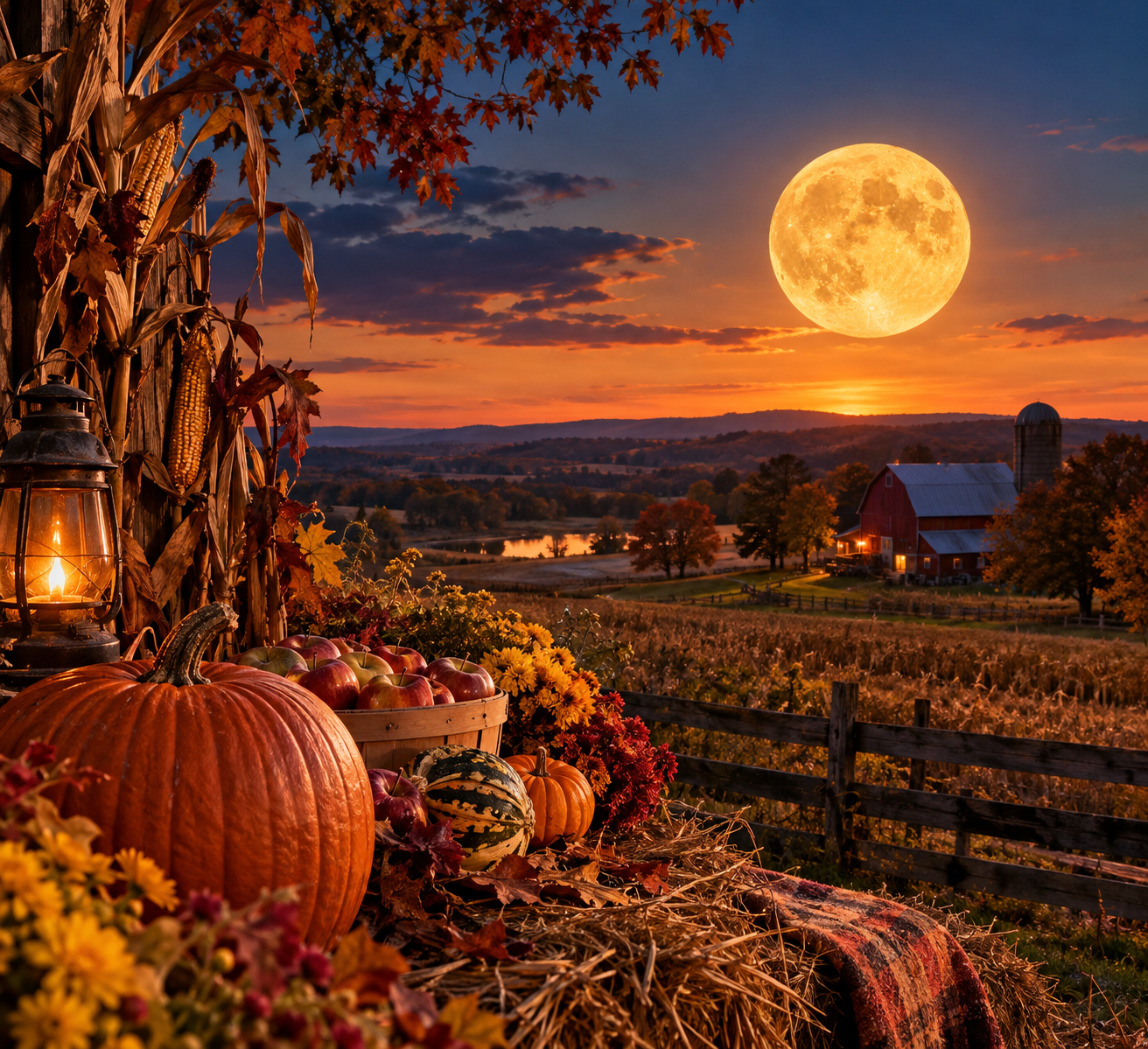
There is something about the Harvest Moon that feels different from any other full moon of the year. Maybe it is the timing. Summer is winding down, the evenings are getting cooler, gardens are beginning to empty out, and autumn is waiting just around the corner. Then comes that enormous, glowing moon, rising over fields and backyards and making an ordinary September evening seem almost enchanted. For generations, people have looked forward to it, celebrated it, worked beneath it, and attached all kinds of traditions and folklore to its arrival.
The Harvest Moon is not just an old-fashioned name for a pretty moon, either. Its history is tied closely to agriculture and the changing seasons, back to a time when the success of a harvest could determine whether a family had enough food to make it through winter. Before electric lights, weather apps, digital calendars, or grocery stores stocked with produce from around the world, people paid very close attention to the sky. The moon was part calendar, part clock, and part reminder that the seasons never stopped moving.
Related: The Harvest Moon Is Here And Fall Is Finally Feeling Real
What Exactly Is The Harvest Moon?
The Harvest Moon is traditionally the full moon that occurs closest to the autumnal equinox. Because the date of the equinox changes slightly from year to year, the Harvest Moon does not always fall on the same date. Most often it occurs in September, although it can occasionally arrive in October.
Its name comes from agriculture rather than astronomy. The timing of this particular full moon historically provided farmers with several evenings of useful moonlight during one of the busiest periods of the agricultural year. As crops ripened and needed to be gathered before the weather changed, that extra light could be a welcome advantage.
There is a practical reason the Harvest Moon can seem especially noticeable, too. Around this time of year, the moon traditionally rises relatively soon after sunset on successive evenings. That meant the transition from daylight to darkness was not quite as abrupt, giving farmers more usable light to finish their work.
For people who depended entirely on daylight and moonlight, that was no small thing.
When The Moon Helped Bring In The Crops
Picture a farm in the days before electricity. The sun has gone down, but the work is not finished. There may still be corn to gather, grain to bring in, vegetables to sort, animals to tend, and equipment to put away. Every day of good weather matters because leaving a crop in the field too long can mean losing some of it to rain, frost, insects, or other problems.
Then the full moon rises.
That bright moonlight could extend the working day and make it possible to continue harvesting after sunset. The moon was not magically making crops grow faster or creating some mysterious agricultural effect. It was simply providing something extremely valuable in a world without artificial lighting: illumination.
Over time, the association between the bright autumn moon and the harvest became so strong that the name stuck.
It is a wonderfully practical origin for something that today feels almost magical.
Harvest Traditions Were About Much More Than Food
Harvest season was one of the biggest turning points of the year for agricultural communities. Bringing in crops was not merely a matter of filling a barn or pantry. It meant preparing for the months ahead.
Families had to decide what would be eaten immediately, what could be stored, and what needed to be preserved. Fruits and vegetables might be dried, pickled, fermented, salted, smoked, or canned. Root vegetables could be stored in cellars, while grains needed to be protected from moisture and pests.
Once the harvest was safely gathered, there was also something worth celebrating.
Harvest festivals developed in many parts of the world, and although their customs differed, they frequently centered around gratitude, food, music, family, community, and the hope that the coming winter would be manageable. A successful harvest was a genuine reason for celebration because everyone understood what could happen when crops failed.
That connection between harvest and gratitude is still sitting quietly underneath many of the autumn traditions we enjoy today.
Related: First Day of Fall in Texas Means Halloween Anyway
The Harvest Moon And Old Folklore
Of course, once humans started paying close attention to the moon, folklore was bound to follow.
The moon has been connected with stories, beliefs, rituals, and superstitions for thousands of years. People living close to the land often watched the moon along with the weather, plants, animals, and changing seasons. Some communities believed particular phases of the moon were favorable for planting or harvesting certain crops. Others associated the full moon with fertility, abundance, good fortune, or changes in the natural world.
Not every old lunar belief had a scientific explanation, and some were undoubtedly superstition. Still, it is worth remembering that ancient and rural communities were constantly observing their surroundings. Before modern scientific instruments were available, people learned by watching patterns.
Sometimes those observations were remarkably useful. Other times, folklore filled in the blanks.
That is how traditions grow. A little practical knowledge gets mixed with a little superstition, somebody tells a story, somebody else adds to it, and several generations later nobody can quite remember where the original idea came from.
Different Cultures Have Their Own Autumn Moon Traditions
The Harvest Moon is not the only autumn moon tradition in the world. In fact, cultures across the globe have developed their own celebrations around the full moon, the harvest, and the changing season.
China’s Mid-Autumn Festival is one of the best-known examples. The festival has a long history and is associated with family gatherings, moon viewing, lanterns, and mooncakes. The full moon became an important symbol of reunion and togetherness, making the autumn moon part of a celebration that continues today.
Japan has another beautiful tradition called Tsukimi, or moon viewing. Traditionally celebrated in autumn, Tsukimi involves admiring the moon and displaying seasonal decorations while enjoying foods associated with the season.
European harvest traditions developed along their own paths. In Britain, harvest festivals became associated with churches, community gatherings, decorations made from crops, and the bringing of harvested food to be displayed or shared.
These customs are different, but there is a familiar idea running through all of them. Autumn gives people a reason to stop for a moment, gather together, appreciate what they have, and look toward the sky.
Why Corn, Wheat, Pumpkins And Apples Became Autumn Symbols
Walk into almost any store in September and you will find the same familiar cast of characters: pumpkins, apples, corn, wheat, gourds, sunflowers, dried leaves, and baskets overflowing with imaginary abundance.
Those decorations did not appear out of nowhere.
Many of the foods and plants we associate with fall were important harvest crops, particularly in agricultural communities. Wheat and other grains represented the staple foods that could be stored for later use. Corn was an important crop in North America. Apples could be eaten fresh, stored, dried, or turned into cider. Squash and pumpkins were useful because they could be stored for extended periods.
Even the familiar sheaf of wheat has a long association with harvest celebrations. It represents the crop being gathered and preserved, and therefore the promise of food during the colder months.
So when somebody decorates their porch with pumpkins, corn stalks, hay bales, and dried flowers, they are unknowingly participating in a very old visual language of autumn.
We just happen to put a cute welcome sign in the middle of it now.
Harvest Suppers And Community Celebrations
One of the most enduring harvest traditions is also one of the simplest: everybody gets together and eats.
Harvest suppers became important community events in many rural areas. After weeks or months of hard work, neighbors could gather around long tables and share meals made from the year’s crops. These celebrations might include music, dancing, games, storytelling, church services, fairs, or other community activities.
There was a practical side to this, too. Harvesting was often a community effort. Families depended on neighbors, relatives, and hired workers to get everything done before the weather turned.
A big harvest meal was therefore about more than celebrating food. It celebrated the people who helped bring that food in.
That is probably why autumn gatherings still have such a familiar feeling today. A fall meal around a crowded table does not need much explanation. Somebody cooks too much, everybody eats too much, and eventually somebody is standing in the kitchen arguing over who gets the last piece of pie.
Some traditions apparently require no updating whatsoever.
The Harvest Moon In Early America
As European settlers established agricultural communities in North America, they brought many of their seasonal customs with them. Those traditions changed over time as settlers adapted to different climates, crops, landscapes, and local practices.
Harvest season became an especially important part of rural American life. Families needed to preserve enough food to carry them through winter, and the work involved much more than simply picking vegetables.
Meat might be smoked or salted. Fruits could be dried or preserved. Vegetables were stored in cellars or preserved in other ways. Grain needed to be harvested and protected. Firewood had to be gathered, animals prepared for winter, and homes made ready for colder weather.
Autumn was therefore a season of both celebration and preparation.
The Harvest Moon arrived right in the middle of all that activity, lighting up the fields while people worked toward the same goal: getting everything ready before winter arrived.
Why People Still Love The Harvest Moon
Modern life has taken much of the urgency out of harvest season for most of us. We can buy strawberries in January, vegetables in the middle of winter, and practically anything else we want with a quick trip to the supermarket.
Most people do not have to calculate how many jars of green beans will get their family through February.
Yet the Harvest Moon still gets our attention.
Maybe that is because autumn has a way of slowing things down. The frantic pace of summer begins to ease. The evenings arrive earlier. Temperatures become more comfortable. Gardens start giving up their last tomatoes and peppers. Leaves begin changing, even if Texas sometimes refuses to get the memo until much later.
The Harvest Moon fits perfectly into that transition.
It feels like a natural pause between seasons, a moment when summer is packing up its bags and autumn is quietly moving into the spare bedroom.
Simple Ways To Celebrate The Harvest Moon Today
There is no official rulebook for celebrating the Harvest Moon, which is probably a good thing. You do not need to recreate an ancient ceremony or spend a fortune decorating your house.
You could simply make an autumn dinner using seasonal ingredients and eat outside if the weather cooperates. You could light a fire, sit on the porch, take a nighttime walk, photograph the moon, or gather the family together for an old-fashioned meal.
If you have a garden, the Harvest Moon is also a lovely excuse to appreciate everything that came out of it during the growing season. Even a few tomatoes from a backyard plant can feel pretty special when you remember that somebody, somewhere, has been growing food and celebrating the harvest for thousands of years.
For those who enjoy folklore and old traditions, the evening can also become a little more intentional. Write down something you are grateful for. Make a seasonal meal. Gather a few autumn leaves or dried flowers. Turn off the television for a while and sit outside beneath the moon.
Sometimes the oldest traditions are the easiest ones to bring back.
A Moon That Connects Us To The Past
The most interesting thing about the Harvest Moon may not be the moon itself. It may be the fact that people have been watching it for so long.
Farmers watched it because its light could help them finish their work. Families watched it because the changing seasons affected everything about their lives. Communities gathered beneath it to celebrate a successful harvest. Storytellers turned it into folklore, and generations carried those stories forward.
Today, most of us are fortunate enough to live in a world where the arrival of winter no longer means wondering whether there will be enough food to last until spring. Still, the seasons continue to turn, gardens continue to produce, and that same moon continues to rise.
So when the Harvest Moon appears this year, step outside and take a look.
You do not have to believe in lunar folklore or follow an ancient tradition to appreciate it. Just remember that for centuries, people stood beneath that same moon with dirt on their hands, crops in their barns, and winter waiting ahead of them.
They looked up and knew it was harvest time.
Maybe that is why the Harvest Moon still feels a little different.
It is not just another full moon. It is a reminder of the old rhythm of the year, when people worked with the seasons instead of simply scheduling around them. And for one bright autumn night, the sky gives us a chance to remember that rhythm too.
Lisa Crow contributed to this article. She is a true crime junkie and lifestyle blogger based in Waco, Texas. Lisa is the Head of Content at Gigi’s Ramblings and Southern Bred True Crime Junkie. She spends her free time traveling when she can and making memories with her large family which consists of six children and sixteen grandchildren.