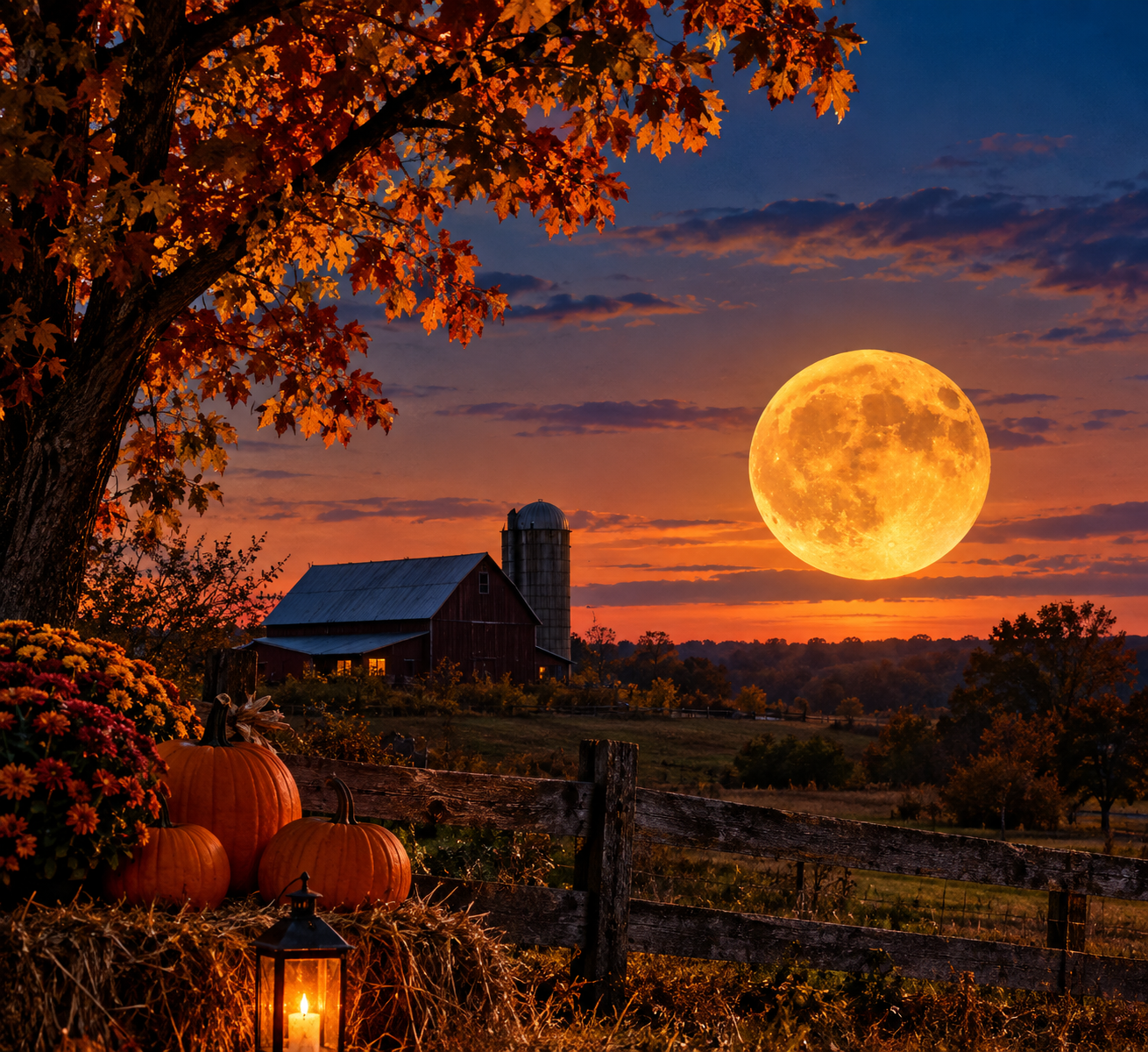
If there is one thing that can make an ordinary September night feel a little more special, it is a big full moon hanging over the neighborhood. This year’s full moon arrives on Saturday, September 26, and it is the Harvest Moon, which seems pretty fitting considering we have officially crossed into fall. The autumn equinox happened on September 22, so summer has officially packed its bags and started heading out, even if the Texas heat has apparently decided it isn’t ready to leave yet. According to NASA, the Harvest Moon will rise in the eastern sky shortly after sunset on September 26, with Saturn appearing nearby and faint Neptune also in the area.
The Harvest Moon has always had a little more personality than your average full moon. Long before we had electric lights, smartphones and the ability to stay up until midnight watching people renovate their kitchens on television, moonlight actually mattered. Farmers were working to get crops harvested, and the extra light provided by the full moon gave them more time to get things done. That is where the name Harvest Moon comes from, and honestly, I think it is one of the prettiest full moon names we have.
Why September’s Full Moon Is Called The Harvest Moon
The Harvest Moon isn’t automatically the full moon that happens in September every year. Instead, it is the full moon closest to the autumnal equinox. Most years that happens in September, although every few years the October full moon gets the title instead. This year, September got lucky because the full moon falls just four days after the equinox.
There is also a pretty interesting reason this particular full moon was so useful to farmers. Around the autumn equinox, the Moon rises closer to the same time from one night to the next than it normally does. Usually, moonrise gets later by roughly 50 minutes each night, but around the Harvest Moon that difference becomes much shorter in the Northern Hemisphere. That means the Moon can show up around sunset for several evenings in a row, giving farmers extra moonlight during one of the busiest times of the year.
Think about that for a minute. Today, we flip a light switch and don’t give it another thought. Back then, a bright moon could literally give somebody extra working time. The same thing we might see as a beautiful fall evening was once a very practical part of getting the year’s harvest safely gathered.
And Yes, The Moon Really Can Look Huge
This is the part that always makes people wonder if the Moon is suddenly closer to Earth.
When the Harvest Moon first comes up over the horizon, it can look absolutely enormous, especially if there are trees, barns, houses or other familiar objects around it. It can also take on that gorgeous golden, yellow or orange color that makes it look like somebody turned the brightness knob all the way up.
The Moon isn’t actually growing larger when it gets close to the horizon. That giant appearance is the famous Moon illusion, which is an effect involving how our brains perceive the Moon in relation to objects around it. The color change is a different matter. When the Moon is low in the sky, its light travels through more of Earth’s atmosphere before reaching our eyes, which can make it appear warmer and more orange or reddish.
So if you step outside Saturday evening and see what looks like a giant orange lantern floating above the trees, don’t panic. The Moon hasn’t suddenly decided to move into the backyard. It just happens to look spectacular from down here.
Saturn Is Crashing The Harvest Moon Party
If you want to make this weekend’s moon watching a little more interesting, keep an eye out for Saturn. NASA says the Harvest Moon will rise near Saturn on September 26, and Saturn should be visible without a telescope. Neptune will also be nearby, although spotting it is considerably more difficult because it is far too faint to see with the naked eye. Binoculars or a telescope will give you a much better shot at finding it.
This is one of those things I love about looking at the night sky. You don’t have to be an astronomer to enjoy it. You can walk outside with absolutely no idea what you’re looking at, spot the Moon, notice that bright little point nearby and then discover that you’re actually looking at a planet nearly a billion miles away.
Suddenly your backyard feels like it has a pretty impressive view.
The Harvest Moon Has A Long History Of Names
People have been naming full moons for a very long time, and the names often tell us something about what was happening on Earth during that part of the year. The Harvest Moon is one of the names that makes immediate sense because it is tied directly to the agricultural season.
You will also see September’s moon referred to as the Corn Moon in some traditions. Full moon names vary across cultures and calendars, and there isn’t one universal list that every society has always used. Many of the names that are popular today came through a mixture of European, Colonial American, Indigenous and modern traditions, so the history behind them is actually a lot more complicated than those cute little moon-name calendars on social media sometimes make it seem.
That doesn’t make the names any less fun, though. If anything, it makes them more interesting because every one of them is a little snapshot of how people once paid attention to the natural world.
And Then There Is The Whole Moon Magic Thing
Of course, you can’t talk about a full moon without eventually wandering into the world of moon rituals, intentions, crystals, candles, astrology and all the other things people associate with lunar energy. Whether you believe the Moon has spiritual influence or you simply enjoy the ritual of doing something meaningful under a full moon, there is something kind of nice about having a reason to slow down for an evening.
The Harvest Moon especially lends itself to thinking about what has happened over the past year. Harvest season is about gathering what has grown, appreciating what worked and figuring out what needs to happen before winter arrives. You don’t have to turn it into some elaborate spiritual ceremony, either. Sit outside for a while, light a candle, write down a few things you’re thankful for or make a list of things you would like to leave behind as the year moves toward its final months.
And if none of that is your thing, that’s perfectly fine too. You can just sit outside with a glass of sweet tea and stare at the Moon. Nobody said you had to get mystical about it.
Does The Full Moon Really Affect Us?
This is where folklore and science take two different roads.
For centuries, people have blamed full moons for everything from strange behavior to sleepless nights. The idea that a full moon can make people act differently has become so deeply embedded in popular culture that we even have the word “lunatic,” which comes from the Latin word for moon.
There have been plenty of studies looking for a connection between the lunar cycle and human behavior, but the evidence for a meaningful effect on things like mood and physiology is limited. Timeanddate notes that there is little hard evidence showing that the Moon has a measurable effect on human physiology and behavior.
That doesn’t mean you can’t enjoy the folklore. Personally, I think there is room for both. You can appreciate the science of what the Moon is doing while still enjoying the stories humans have built around it for thousands of years.
How To Enjoy The Harvest Moon Without Making A Big Production Out Of It
The best part about this particular full moon is that you really don’t need anything special to enjoy it. Find a spot where you have a decent view of the eastern horizon and step outside around sunset on Saturday. The Moon will rise shortly after sunset, and it should be especially pretty while it is still low in the sky.
If you’ve got binoculars, take them with you. If you’ve got a telescope, even better. If all you’ve got is your own two eyes, well, those work just fine too. You can even make an evening of it by sitting outside with a blanket, making some hot cider or coffee, putting your phone down for a little while and actually paying attention to what’s happening above you.
And don’t worry if you miss the exact moment the Moon becomes officially full. The Moon will look full and bright on the nights surrounding September 26 as well, so you have more than one opportunity to catch it.
Maybe The Best Thing About The Harvest Moon Is What It Reminds Us
We spend an awful lot of time rushing through the year without noticing how much has changed around us. One minute we’re complaining about summer heat, and suddenly we’re talking about pumpkin season, football, cooler evenings and whether the trees are going to give us a decent show of color this year.
The Harvest Moon lands right in that transition. It shows up after the equinox, when the days are getting shorter and the nights are getting longer, and it gives us one more beautiful reminder that the seasons keep moving whether we are paying attention or not.
Maybe that’s why this particular full moon has lasted in our traditions for so long. It isn’t just a pretty thing in the sky. It represents a turning point. It is about gathering, preparing, appreciating what the year has produced and getting ready for whatever comes next.
So Saturday night, if you happen to glance out the window and see a big glowing Harvest Moon climbing into the sky, go outside for a minute. You don’t need a ritual, a telescope, a crystal collection or a degree in astronomy. Just take a little time to enjoy it.
And if Saturn happens to be hanging around nearby, well, that’s just the universe showing off a little.
Lisa Crow contributed to this article. She is a true crime junkie and lifestyle blogger based in Waco, Texas. Lisa is the Head of Content at Gigi’s Ramblings and Southern Bred True Crime Junkie. She spends her free time traveling when she can and making memories with her large family which consists of six children and sixteen grandchildren.