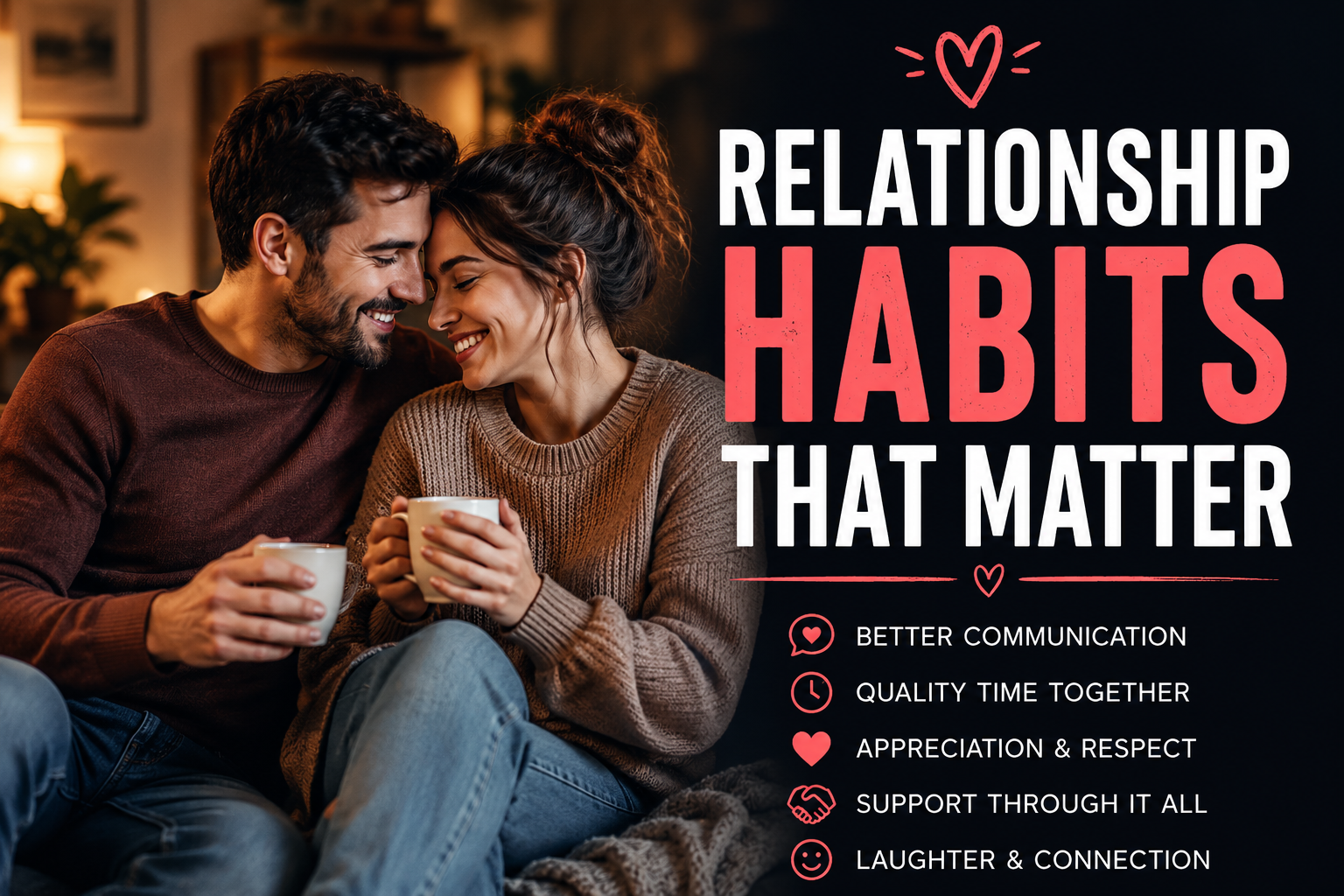
Couple sitting together on a couch smiling and holding warm drinks beside bold text reading “Relationship Habits That Matter” with relationship tips listed alongside them.

Every relationship goes through seasons. Some days feel effortless, while others take a little more patience and intention. The couples who stay strong long-term are not usually the ones with perfect lives or nonstop romance. More often, they are the ones who consistently practice small habits that help them stay connected.

The truth is, relationships are built in everyday moments. A quick conversation in the kitchen, a text during the workday, laughing over something silly, or simply showing up for each other when life gets stressful all matter more than grand gestures people post online.

If you want a healthier, happier relationship, these habits are worth paying attention to.

Communicate Before Problems Explode

A lot of couples wait too long to speak up. By the time they finally talk about what is bothering them, frustration has already built into resentment.

Healthy communication is not about winning arguments. It is about understanding each other. That means talking honestly about needs, stress, expectations, and feelings before things spiral out of control.

Even small check-ins help. Asking “How are you really doing?” can open the door to conversations that keep couples connected instead of drifting apart.

Listening matters just as much as talking. Sometimes your partner does not need a solution. They simply want to feel heard.

Put Down the Phones Sometimes

It is easy to sit beside someone while mentally being somewhere else entirely. Scrolling during dinner, watching separate videos on the couch, or checking notifications every few minutes slowly chips away at quality time.

You do not have to unplug from the world completely, but intentional moments without distractions make a huge difference.

Couples who spend real time together tend to feel more emotionally connected. That can be as simple as cooking supper together, watching a movie without multitasking, taking an evening drive, or sitting outside talking after a long day.

Small moments of attention often mean more than expensive date nights.

Keep Dating Each Other

One mistake many couples make is assuming the effort stops once the relationship feels secure.

Long-term relationships still need excitement, thoughtfulness, and fun. People change over time, and couples who continue learning about each other tend to stay closer emotionally.

Date nights do not have to be fancy or expensive. Some of the best memories come from simple traditions. Maybe it is grabbing takeout and riding around looking at Christmas lights, having movie nights at home, trying a new restaurant, or taking a weekend road trip together.

The important part is making time for each other on purpose.

Show Appreciation Often

Feeling unappreciated can quietly damage a relationship over time.

Most people want to feel noticed for the things they do, even the small everyday stuff. Saying thank you, complimenting your partner, or acknowledging their effort helps create a stronger emotional connection.

It takes only a few seconds to say:

  • “I appreciate you.”
  • “Thanks for handling that.”
  • “You’ve been working really hard lately.”
  • “I’m glad we’re doing life together.”

Those simple words carry more weight than people realize.

Learn How Your Partner Handles Stress

People react differently under pressure. One person may want to talk everything out immediately while the other needs quiet time to process.

Understanding how your partner responds to stress can prevent unnecessary arguments. Instead of assuming the worst, try recognizing when they are overwhelmed, exhausted, or mentally drained.

Relationships become stronger when couples feel safe being imperfect around each other.

Sometimes support looks like deep conversations. Other times it looks like bringing home supper after a rough day or handling something without being asked.

Stop Keeping Score

Healthy relationships are partnerships, not competitions.

Keeping a mental score of who did more chores, spent more money, apologized first, or sacrificed more creates resentment fast. Real relationships require give and take from both people at different times.

There will be seasons where one person carries more weight because life happens. Stress, work, health issues, family responsibilities, and exhaustion all affect relationships.

Strong couples focus less on tallying points and more on helping each other through hard seasons.

Laugh Together More

Humor matters more than people think.

Couples who laugh together often tend to handle stress better and recover from conflict faster. Shared jokes, playful teasing, funny stories, and random moments of silliness create emotional closeness.

Life gets heavy sometimes. Being able to laugh together in the middle of everyday chaos helps relationships feel lighter.

Even years later, those inside jokes and goofy memories become part of what keeps couples connected.

Respect Each Other During Arguments

Disagreements are normal. Every couple argues sometimes. What matters is how those arguments are handled.

Name-calling, mocking, bringing up old mistakes, or intentionally hurting each other during fights leaves damage behind. Respect should still exist even when emotions run high.

Healthy conflict usually involves:

  • Staying calm when possible
  • Listening without interrupting
  • Avoiding personal attacks
  • Focusing on the actual issue
  • Taking a break if things get too heated

You can disagree without tearing each other down.

Make Home Feel Safe

One of the most important relationship habits is creating emotional safety.

People want to feel accepted at home. They want to know they can vent, be vulnerable, admit mistakes, and express emotions without fear of ridicule or constant criticism.

That does not mean avoiding accountability. It simply means approaching each other with kindness instead of hostility.

When home feels peaceful and supportive, relationships tend to thrive.

Related: The Impact of Technology on Modern Relationships

Never Stop Choosing Each Other

Long-lasting relationships are rarely built on constant butterflies and perfect moments. They are built through consistency, loyalty, patience, and intentional effort over time.

The strongest couples continue choosing each other through busy schedules, stressful seasons, financial struggles, family chaos, and all the ordinary moments in between.

In the end, the habits that matter most are often the simplest ones. Listening. Laughing. Showing appreciation. Spending time together. Offering support. Staying kind even during difficult days.

Those little things add up to something big.

Conclusion

Healthy relationships are not about perfection. They are about connection, effort, and the willingness to keep showing up for each other every day. Small habits may seem insignificant in the moment, but over time they shape the foundation of a strong and lasting partnership.

The couples who stay close are usually the ones who continue nurturing their relationship long after the honeymoon phase fades. Consistency, communication, appreciation, and quality time matter far more than flashy gestures ever will.

At the end of the day, relationships thrive when both people feel loved, respected, valued, and supported through every season of life.

Lisa Crow contributed to this article. She is a true crime junkie and lifestyle blogger based in Waco, Texas. Lisa is the Head of Content at Gigi’s Ramblings and Southern Bred True Crime Junkie. She spends her free time traveling when she can and making memories with her large family which consists of six children and sixteen grandchildren.


Dramatic scene of a couple in a heated argument with shattered glass and intense red lighting symbolizing emotional turmoil and crimes of passion.

Crimes of passion have fascinated society for centuries. From courtroom trials to late-night true crime documentaries, people cannot look away when emotions spiral out of control. However, what actually happens in the brain when someone snaps?

Let’s break down the psychology behind crimes of passion, what fuels them, and why intense emotion can override logic in seconds.

What Are Crimes of Passion?

A crime of passion is typically a violent act committed in the heat of the moment, triggered by overwhelming emotion rather than careful planning. These cases often involve romantic betrayal, jealousy, humiliation, or family conflict.

Unlike premeditated crimes, the defining feature is immediacy. Something happens. Emotions surge. A decision is made in seconds that changes lives forever.

The common thread is emotional overload.

Related: How to Spot the Signs of a Narcissist

Emotional Hijacking and the Brain

Psychologists describe something known as an amygdala hijack. The amygdala processes fear and anger. When it perceives a threat, whether real or perceived, it activates the fight or flight response.

At the same time, the prefrontal cortex, which handles reasoning and impulse control, temporarily loses influence.

In simple terms, emotion hits the gas while logic struggles to catch up.

During this state, heart rate increases, adrenaline floods the body, tunnel vision sets in, and risk assessment drops significantly. This neurological surge explains how someone can go from calm to catastrophic in moments. It does not excuse violent behavior, but it does explain the mechanism behind it.

Jealousy, Possession, and Identity Threat

Jealousy is one of the strongest emotional triggers behind crimes of passion. When someone ties their identity, security, or self-worth to a partner or family member, perceived betrayal can feel like total destruction.

It stops feeling like hurt feelings and starts feeling like survival.

Protective instincts are deeply wired into us. And I am going to keep it real in the tone you wanted included.

I ain’t even gonna lie, mess with my husband and there is a good chance you will end up hurt. Actually, you both will end up hurt. One thing I do not play about is my family.

That protective surge is biological. Acting on it violently is still a choice.

There is a major difference between feeling protective and committing harm. The emotion is automatic. The action is not.

Impulse Control and Risk Factors

Not everyone who feels rage commits violence. So what increases the risk?

Research shows several contributing factors, including poor impulse control, unresolved trauma, substance abuse, personality disorders, and learned patterns of aggression from childhood.

When intense emotional reactivity combines with weak emotional regulation, the likelihood of reactive violence rises dramatically.

In other words, passion alone is not enough. It is passion combined with poor control.

Media and the Romanticizing of Rage

Culturally, society often frames crimes of passion as tragic love stories. Movies and television sometimes portray explosive jealousy as proof of devotion.

However, healthy love does not equal possession. Healthy love does not equal retaliation. Healthy love does not equal control.

When violence is romanticized, it subtly reinforces the idea that extreme emotion justifies extreme action. It does not.

Legal Perspective on Crimes of Passion

Historically, some courts treated crimes of passion more leniently than premeditated murder, arguing that the offender temporarily lost control.

Modern legal systems are far less sympathetic. Emotional distress may explain behavior, but it rarely removes accountability.

The law recognizes what psychology confirms. Emotion influences behavior, but it does not eliminate responsibility.

Can Crimes of Passion Be Prevented?

Yes, and prevention starts long before a breaking point.

Protective factors include emotional regulation skills, conflict resolution tools, therapy, reduced substance use, and strong support systems.

Learning to pause during escalation is critical. Even stepping away for sixty seconds can allow the rational brain to re-engage and lower the intensity of the reaction.

Final Thoughts

The psychology behind crimes of passion reveals something uncomfortable about human nature. Humans are deeply emotional creatures. Love, jealousy, anger, and betrayal can feel overwhelming.

Feeling protective over your family is human. Feeling furious over betrayal is human. Letting that fury dictate irreversible violence is preventable.

Passion explains behavior. It does not excuse it.

Lisa Crow contributed to this article. She is a true crime junkie and lifestyle blogger based in Waco, Texas. Lisa is the Head of Content at Gigi’s Ramblings and Southern Bred True Crime Junkie. She spends her free time traveling when she can and making memories with her large family which consists of six children and fifteen grandchildren.

lady ignoring red flag

We’ve all seen it. Felt it. That little warning bell that goes off when something doesn’t sit right. The problem isn’t that we miss red flags. It’s that we talk ourselves out of them.

Red flags don’t usually show up screaming. They whisper. They nudge. And if you ignore them long enough, they turn into full-blown disasters.

This applies to relationships, friendships, jobs, family dynamics, and even your own habits. If something feels off, there’s usually a reason.

Red Flags Are Your Gut Speaking Plain English

Your intuition doesn’t need evidence. It notices patterns before your brain catches up. That tight feeling in your chest, the sudden hesitation, the urge to pause — that’s not anxiety. That’s awareness.

People ignore red flags because they want to be polite, hopeful, or forgiving. But your gut isn’t rude. It’s protective.

When you dismiss those instincts, you’re choosing comfort over clarity.

Small Red Flags Grow Teeth

Most red flags don’t start as deal-breakers. They start small.

A comment that feels disrespectful. A promise that keeps getting delayed. A story that changes just enough to make you wonder. On their own, they seem harmless. Together, they paint a picture.

Ignored long enough, those small signs turn into patterns. And patterns don’t lie.

Love Doesn’t Require You to Ignore Yourself

One of the biggest lies people believe is that love means patience at all costs. It doesn’t.

Real love doesn’t ask you to silence your instincts or shrink your boundaries. It doesn’t make you feel confused, uneasy, or constantly second-guessing your reality.

If you feel like you’re always explaining away someone’s behavior, that’s not love. That’s self-abandonment.

Red Flags Aren’t Always About Other People

Sometimes the red flag is you.

Staying when you know better. Making excuses you wouldn’t accept for anyone else. Ignoring your own limits because walking away feels uncomfortable.

Growth starts when you stop gaslighting yourself.

Ignoring Red Flags Costs You Time

Time is the one thing you don’t get back. Every red flag ignored is time spent in a situation that isn’t aligned with who you are or where you’re headed.

Listening early saves years of regret, resentment, and recovery.

Walking away at the first warning isn’t dramatic. It’s disciplined.

Trusting Yourself Is a Skill You Can Relearn

If you’ve ignored red flags before, you’re not broken. You were likely taught to be agreeable, understanding, or self-sacrificing.

The good news is intuition gets stronger the more you honor it. Each time you listen, it speaks louder. Each time you act, you trust yourself more.

That’s power.

The Bottom Line

Red flags aren’t there to scare you. They’re there to guide you.

Ignoring them doesn’t make them disappear. It just delays the lesson.

Pay attention. Trust your gut. And remember — peace is louder than chaos once you learn how to listen.

16 years anniversary post

Sixteen years. If we’re being honest, I don’t think either of us—or anybody watching from the cheap seats—would’ve guessed we’d make it this far. Not because we didn’t love each other, but because we walked into this thing with more chaos than calm, more questions than answers, and absolutely no blueprint on how to blend two very different worlds.

He had never been in a serious relationship before me. Never lived with anyone but his parents. Never had the kind of structure most folks grow up with. Meanwhile, I came in like a whole tornado of organization, expectations, and routines. It wasn’t exactly a seamless transition.

The Growing Pains That Shaped Us

There were moments where we almost fell apart. Moments where I felt like I was raising another kid—kind of—because he missed a lot of basic life skills growing up while his parents were off in a bar instead of at home. He was used to utter chaos and mess. It took patience, teaching, and a whole lot of deep breaths.

But let’s be real: I’m no picnic either. My dominant personality can be… a lot. I like things done a certain way, and I don’t bend easily. So trust me, the growing pains were on both sides.

Why Our Relationship Works

Some folks would call us co-dependent because we do almost everything together. Outside of work, you’ll rarely find us apart. And you know what? It works. Other people don’t have to understand our rhythm or our routine. We figured out a long time ago who to keep at a distance and who doesn’t need to be anywhere near our relationship.

We’ve changed a lot over sixteen years. We are now in our calm era. All the kids have grown up and started families of their own. He went from never being in a relationship to being a partner, a stepdad, and a PawPaw to fifteen grandkids in record time. And he handled it like a champ, even when life handed us more chaos than calm.

The Quiet Moments Matter Most

This year, our anniversary weekend was exactly the way we like it—quiet, simple, no stress, no circus. Just us enjoying the calm we built together. We’ll probably take a little celebratory road trip before the month’s over, nothing fancy, just one of those easy adventures that always ends up being our favorite kind.

Sixteen Years of Choosing Each Other

Right now, I’m just grateful. Grateful that after all the hard moments, all the learning, all the adjusting, all the storms, I still have someone walking beside me through this wild, ridiculous life. We’ve laughed, fought, rebuilt, raised kids, spoiled grandbabies, and somehow made it through every bit of it without killing each other—and that alone deserves a trophy.

It’s been one helluva ride. But I’d do it all again. Every last minute of it. Here’s to 160 more with my bestie!

Lisa Crow contributed to this article. She is a true crime junkie and lifestyle blogger based in Waco, Texas. Lisa is the Head of Content at Gigi’s Ramblings and Southern Bred True Crime Junkie. She spends her free time traveling when she can and making memories with her large family which consists of six children and fifteen grandchildren.

couple on cell phones

Technology has changed almost every aspect of our lives, including how we connect with others. From texting to video calls, relationships today look very different than they did a few decades ago. While technology makes it easier to stay in touch, it also brings challenges that can affect communication, trust, and emotional connection. I’m GenX, so I’ve experienced both sides of the spectrum.

Instant Communication: A Blessing and a Curse

Gone are the days of waiting for a letter in the mail. Now, a simple text or voice message can instantly reach someone across the world. This is great for keeping in touch, especially in long-distance relationships. However, instant communication can also lead to misunderstandings.

Text messages lack tone and body language, making it easy to misinterpret someone’s words. A short reply like “Okay” could be seen as annoyed when, in reality, the person is just busy. Emojis and GIFs help add some personality, but they’re not always enough to prevent miscommunication.

social media and relationships

Social Media: Connecting or Causing Conflict?

Social media helps people stay connected, but it also comes with challenges. Seeing a partner like or comment on someone else’s post can spark jealousy. My husband despises any form of social media for this very reason. Couples may also compare their relationships to the “perfect” ones they see online, leading to unrealistic expectations.

On the other hand, social media can strengthen relationships. Posting about a partner or sharing memories online can be a fun way to express love. The key is balance—enjoying social media without letting it interfere with real-life interactions.

Online Dating: Expanding the Possibilities

Finding love has never been easier. Dating apps and websites have made it possible to meet people outside of our usual social circles. Instead of waiting for fate to bring two people together, a simple swipe can lead to a new connection.

While online dating has created more opportunities, it also comes with risks. People can misrepresent themselves, leading to disappointment when meeting in person. Additionally, the endless options on dating apps can make commitment feel overwhelming.

I recently was hired for a data analyst project for several dating sites and my advice would be to stay very vigilant. There are many fake profiles just looking to scam some poor unsuspecting soul. Always do your due diligence if you plan on connecting with someone online. Still, when used wisely, technology can help people find meaningful relationships.

The Impact on Face-to-Face Interaction

With texting and social media being so common, in-person communication sometimes takes a backseat. Couples may spend time together physically but remain glued to their screens. This can lead to a lack of deep conversation and emotional connection.

Making time for face-to-face interaction is essential. Whether it’s a date night without phones or a simple conversation over coffee, unplugging from technology helps strengthen relationships.

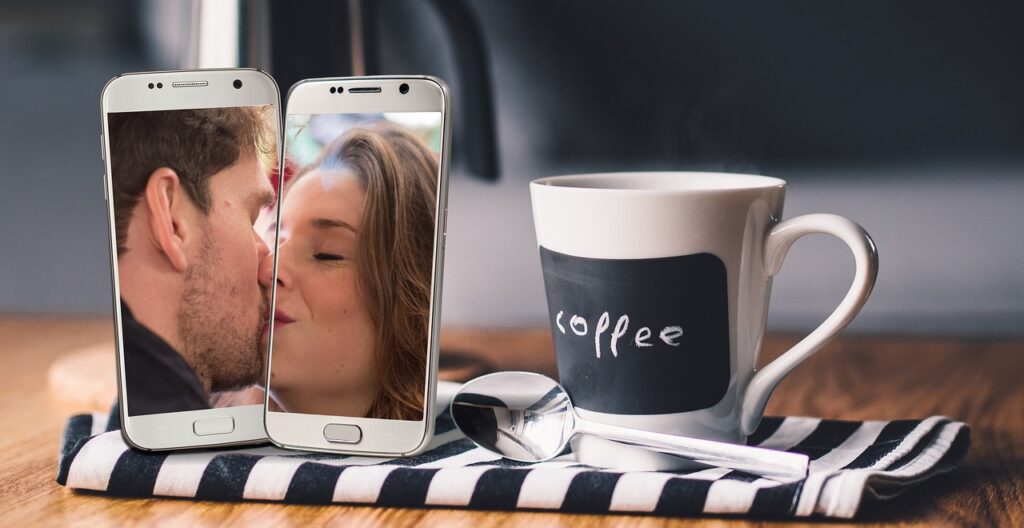
couple video calls

Image by Gerd Altmann from Pixabay

Video Calls: Keeping Love Alive Across Distances

Long-distance relationships are much easier now, thanks to video calls. Couples who live miles apart can still have “face-to-face” conversations through platforms like Zoom, FaceTime, and WhatsApp. This makes it easier to maintain intimacy and feel connected.

However, virtual communication is not the same as being together in person. Physical presence, hugs, and shared experiences are important in relationships. Technology can help bridge the gap, but it can’t completely replace real-life interaction.

Technology and Relationship Boundaries

Technology has created new challenges when it comes to boundaries. Some people expect instant replies to texts, which can lead to frustration if one person needs space. Others may feel uncomfortable with their partner’s online behavior, such as excessive social media use or interactions with strangers. We won’t even go into adult sites because my feelings are so strong on this and I am definitely biased. I will say, it’s a big HELL NO in my relationship!

Setting clear boundaries is important. Discussing things like phone use during dates, social media expectations, and privacy helps prevent misunderstandings. Healthy relationships require trust, and technology should support that trust rather than break it down.

Final Thoughts

Technology has transformed modern relationships in both positive and challenging ways. While it helps people stay connected, it also requires careful navigation to avoid communication issues, social media conflicts, and screen-time distractions.

The key is balance. Using technology to enhance relationships rather than replace real-life interactions leads to deeper connections. Whether through texting, video calls, or social media, technology should bring people closer, not push them apart.

Related: Cozy Winter Date Ideas That Don’t Break the Bank

Lisa Crow contributed to this article. She is a true crime junkie and lifestyle blogger based in Waco, Texas. Lisa is the Head of Content at Gigi’s Ramblings and Southern Bred True Crime Junkie. She spends her free time traveling when she can and making memories with her large family which consists of six children and fifteen grandchildren.

This website may contain affiliate links, including links to products on Amazon. As an Amazon Affiliate, I earn from qualifying purchases. This does not affect your purchase price but helps support the site at no additional cost to you. Thank you for your support!