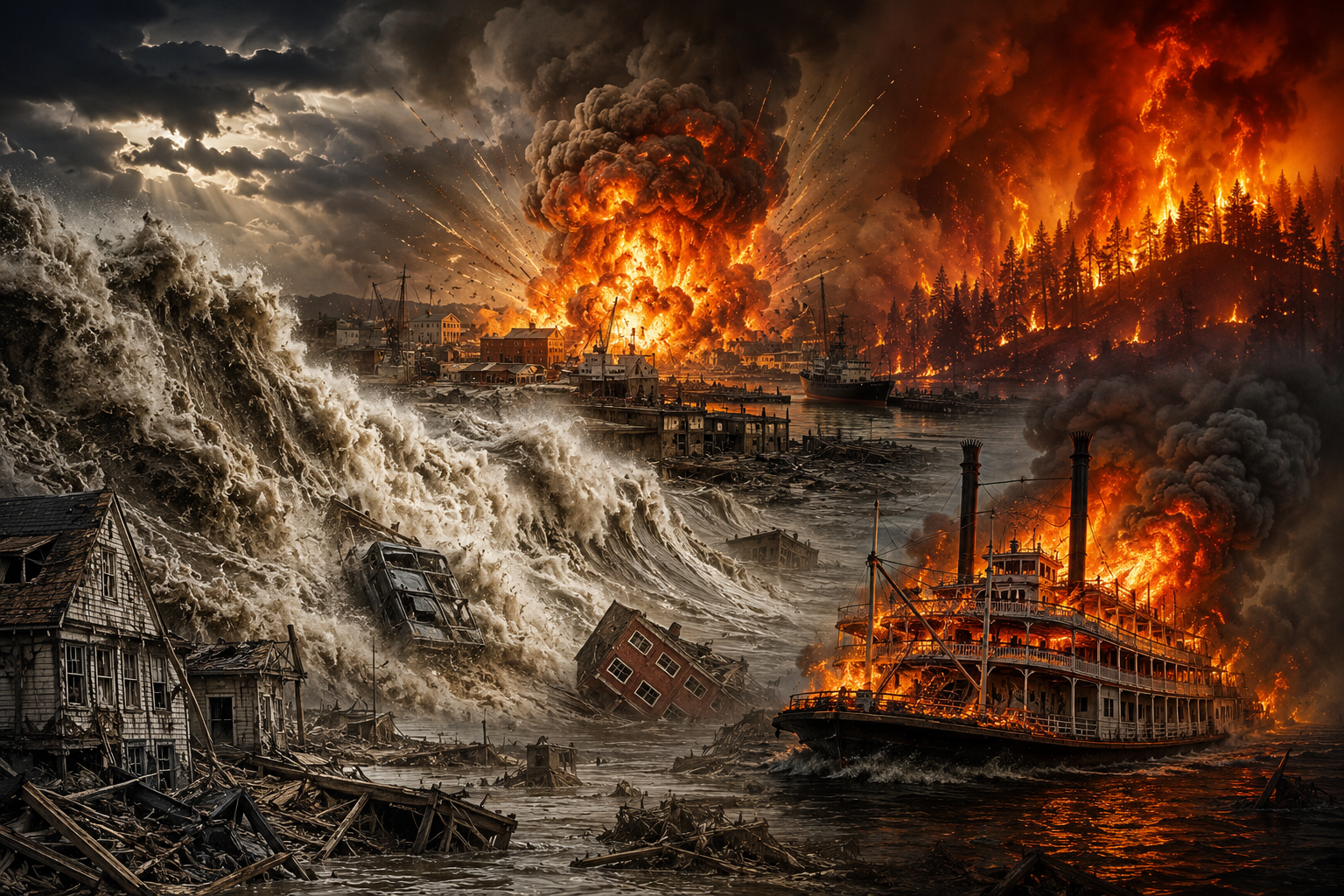
Dramatic collage depicting forgotten historic disasters including floods, explosions, wildfires, and maritime tragedies.

History remembers the biggest tragedies, but many devastating disasters have quietly faded from public memory. While events like the Titanic and Hurricane Katrina remain widely discussed, countless other catastrophes once dominated headlines and changed lives forever before slipping into obscurity.

Here are some of the deadliest and most fascinating disasters that deserve to be remembered.

The Great Molasses Flood (1919)

It sounds almost unbelievable, but on January 15, 1919, a massive storage tank in Boston burst and released more than two million gallons of molasses into the streets.

The sticky wave reportedly reached speeds of up to 35 miles per hour, destroying buildings, overturning vehicles, and trapping people in its path. Twenty-one people lost their lives, and more than 150 others were injured.

The disaster led to significant changes in industrial safety regulations and remains one of the strangest tragedies in American history.

The Peshtigo Fire (1871)

When Americans think of historic fires, the Great Chicago Fire usually comes to mind. However, the Peshtigo Fire in Wisconsin occurred on the very same day and was far deadlier.

Fueled by drought conditions and powerful winds, the firestorm consumed entire communities. Estimates suggest between 1,200 and 2,500 people died, making it the deadliest wildfire in United States history.

Because the Chicago disaster captured national attention, many people have never even heard of Peshtigo.

The Halifax Explosion (1917)

During World War I, two ships collided in the harbor of Halifax, Nova Scotia. One of the vessels was carrying explosive wartime cargo.

The resulting blast was one of the largest human-made explosions before the atomic age. Entire neighborhoods were leveled, nearly 2,000 people died, and thousands more were injured.

The shockwave shattered windows miles away and permanently changed the city.

The Johnstown Flood (1889)

Heavy rains caused a poorly maintained dam to fail above Johnstown, Pennsylvania.

What followed was a wall of water that tore through the valley, destroying homes, businesses, and everything else in its path. More than 2,200 people died in just a matter of hours.

The tragedy sparked public outrage and increased scrutiny of infrastructure safety across the country.

The Sultana Steamboat Disaster (1865)

Just weeks after the end of the Civil War, the steamboat Sultana exploded and caught fire on the Mississippi River.

The vessel was carrying thousands of recently released Union prisoners of war and was severely overcrowded. An estimated 1,800 people died, making it the deadliest maritime disaster in American history.

Despite its enormous death toll, it was largely overshadowed by the assassination of President Abraham Lincoln occurring around the same time.

Related: Tornado Alley Explained: What It Is and Why It Matters

The Tangshan Earthquake (1976)

One of the deadliest earthquakes ever recorded struck Tangshan, China, while most residents were asleep.

Official figures place the death toll at around 242,000 people, although some estimates suggest the number may have been significantly higher.

The disaster destroyed much of the city within seconds and remains one of the most catastrophic natural disasters of the twentieth century.

The Banqiao Dam Failure (1975)

Typhoon Nina brought extraordinary rainfall to central China, causing the Banqiao Dam and dozens of other dams to collapse.

Massive flooding swept across communities, leading to widespread destruction. Combined deaths from flooding, disease, and famine may have exceeded 170,000 people.

Outside of China, the disaster remains surprisingly little known despite its staggering scale.

The Texas City Disaster (1947)

A ship loaded with ammonium nitrate caught fire while docked in Texas City, Texas.

The explosion triggered additional fires and blasts throughout the area. Nearly 600 people died, thousands were injured, and much of the industrial waterfront was destroyed.

The event remains one of the deadliest industrial accidents in American history.

Related: The Most Common Myths About Lightning Strikes

Why We Forget

Some disasters disappear from public memory because they happened long ago. Others were overshadowed by wars, political events, or larger headlines. In many cases, entire generations pass before the stories are revisited.

Yet these tragedies shaped laws, improved safety standards, transformed communities, and changed the lives of countless families. Remembering them helps us understand not only the past but also the lessons that continue to protect us today.

History is filled with disasters that once shocked the world. The fact that many of us have never heard of them may be one of the most fascinating stories of all.

Lisa Crow contributed to this article. She is a true crime junkie and lifestyle blogger based in Waco, Texas. Lisa is the Head of Content at Gigi’s Ramblings and Southern Bred True Crime Junkie. She spends her free time traveling when she can and making memories with her large family which consists of six children and sixteen grandchildren.

Girl Scouts selling cookies at a neighborhood cookie booth with colorful boxes of Thin Mints, Samoas, and other varieties displayed on a table.

How the Girl Scouts Began

The story of the Girl Scouts of the USA begins in 1912 when Juliette Gordon Low gathered a small group of girls in Savannah. Her vision was simple but powerful. She wanted girls to gain confidence, leadership skills, and practical knowledge that would prepare them for the world.

At the time, opportunities for girls were limited. Because of that, Low believed girls should experience adventure, outdoor activities, and teamwork just like boys did. As a result, the organization quickly grew. Troops began forming across the United States, and the Girl Scouts became known for encouraging independence, service, and community involvement.

Throughout the early years, members learned skills such as camping, cooking, sewing, first aid, and leadership. Over time, these experiences helped build a strong foundation for the organization. Today, the Girl Scouts remain one of the most recognizable youth programs in America.

The Unexpected Beginning of Girl Scout Cookies

Believe it or not, the famous cookies did not begin as a national business plan. Instead, the tradition started in 1917 when a troop in Muskogee decided to raise money for activities.

At first, the cookies were baked at home by the girls themselves. Simple sugar cookies were prepared in family kitchens and then sold door-to-door in the neighborhood. Because the idea worked so well, other troops began doing the same thing.

Before long, cookie sales became one of the most popular fundraising traditions in the organization. By the 1920s, cookie recipes were even published in Girl Scout magazines so troops everywhere could participate.

Eventually, demand grew too large for homemade baking. Therefore, commercial bakeries were brought in to help supply cookies while still allowing troops to manage local sales.

Related: Easy Summer Activities for Grandparents and Kids

How Girl Scout Cookies Became a National Tradition

By the 1930s, cookie sales had grown so popular that official bakers were chosen to supply the treats. This allowed troops across the country to sell consistent products while still raising funds for local programs.

Over the decades, cookie varieties expanded. While the original recipes were fairly simple, new flavors were introduced to keep things exciting. Some cookies quickly became fan favorites and returned year after year.

For many Americans, buying cookies became a yearly tradition. Neighborhoods would watch for tables outside grocery stores, and families looked forward to supporting local troops. Because the program teaches entrepreneurship, girls learn valuable skills in communication, budgeting, and goal setting.

Today, the cookie program is considered one of the largest youth-led business efforts in the world.

The Most Popular Girl Scout Cookies

Several cookies have reached legendary status over the years. While flavors sometimes rotate, a few varieties remain consistently popular.

One of the most recognizable cookies is the Thin Mints. These chocolate-covered mint cookies are famous for their crisp texture and cool flavor.

Another longtime favorite is the Samoas, which feature caramel, toasted coconut, and chocolate stripes. The sweet and chewy combination keeps fans coming back every season.

Peanut butter lovers often reach for the Tagalongs. These cookies include a crunchy base topped with peanut butter and coated in chocolate.

Although cookie names sometimes change depending on the bakery producing them, the flavors themselves have remained beloved for decades.

Related: The Rise of Backyard Businesses

Why Cookie Season Is Such a Big Deal

For many families, cookie season feels almost like a small holiday. Tables appear outside stores, order forms get passed around offices, and social media fills with cookie announcements.

However, the tradition is about more than just sweets. The program is designed to teach business skills in a real-world environment. Girls practice goal setting, customer service, teamwork, and financial literacy while managing their sales.

Because of that, cookie season has become a meaningful experience for millions of young people across the country. Troops use the funds raised to support community service projects, camping trips, leadership programs, and educational opportunities.

The Lasting Impact of Girl Scout Cookie Culture

More than a century after the first troop sold homemade cookies, the tradition continues to thrive. The cookie program remains a major part of the identity of the Girl Scouts of the USA and has helped generations of girls learn valuable life skills.

At the same time, cookie season has become a cherished American tradition. Families look forward to their favorite flavors each year, and communities continue to support local troops.

What started as a small neighborhood fundraiser has grown into a cultural phenomenon. Yet the heart of the program remains the same. Girls are given the chance to learn, lead, and build confidence one cookie box at a time. 🍪

Lisa Crow contributed to this article. She is a true crime junkie and lifestyle blogger based in Waco, Texas. Lisa is the Head of Content at Gigi’s Ramblings and Southern Bred True Crime Junkie. She spends her free time traveling when she can and making memories with her large family which consists of six children and sixteen grandchildren.