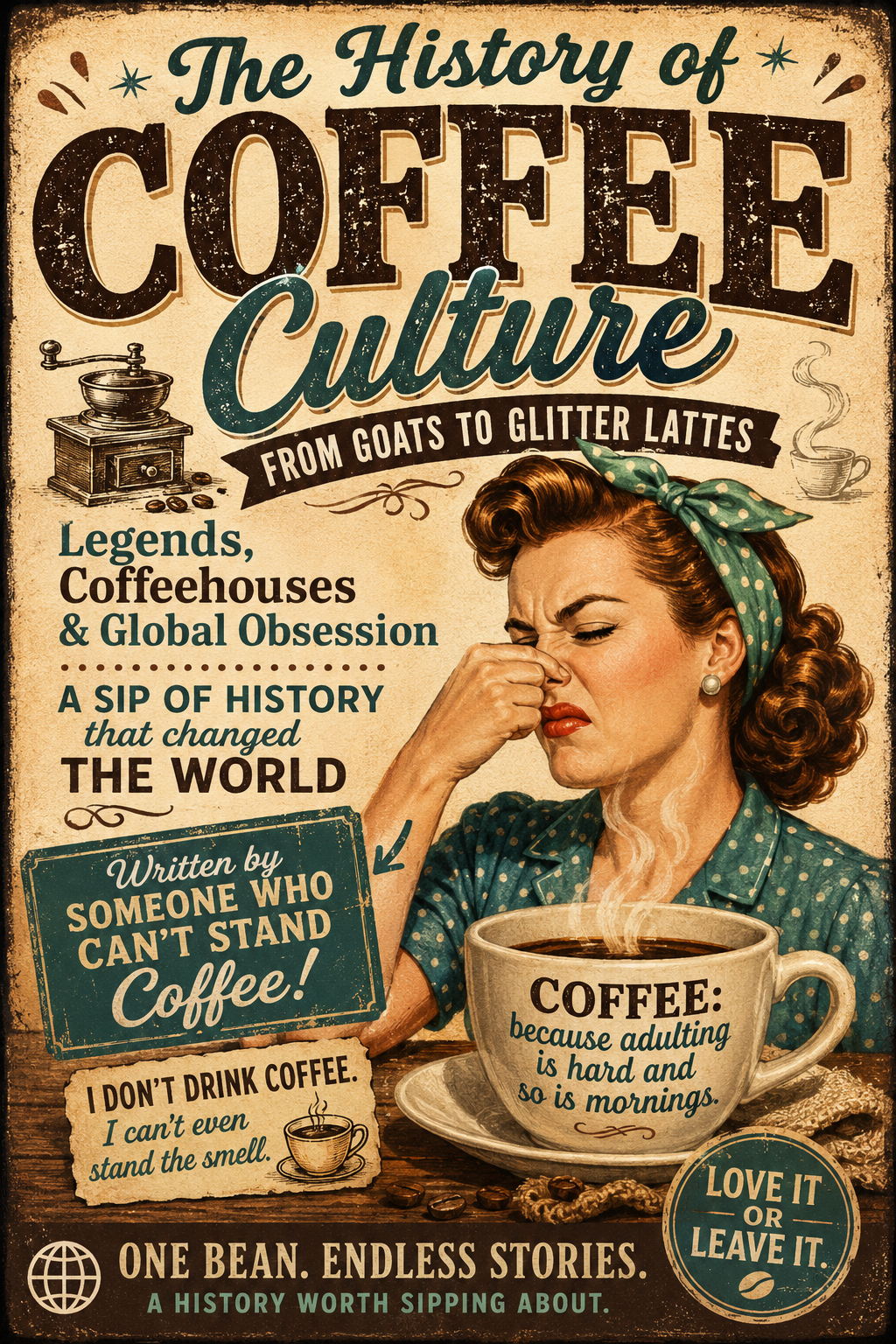
Coffee has been bringing people together for centuries, and these days it has become more than just a morning pick-me-up. It is a personality trait, a fashion statement, a social event, and for some folks, practically a religion. Whether people are waiting in line for the newest seasonal latte or perfecting their pour-over technique at home, coffee culture has taken on a life of its own.
Now, before all the coffee lovers start clutching their mugs, I have a confession. I do not drink coffee. I can’t even stand the smell of it. Walking into a coffee shop is a little like walking into a candle store that’s burning one giant “Dark Roast Supreme” candle. It simply isn’t my thing. That said, I have always found the history behind coffee absolutely fascinating because few drinks have shaped culture, business, politics, and everyday life quite like this one.
A Goat May Have Started It All
Like many ancient stories, coffee’s origins come with a healthy dose of legend. According to popular folklore, an Ethiopian goat herder named Kaldi noticed his goats becoming unusually energetic after nibbling bright red berries from a certain shrub. Curious, he sampled them himself and experienced the same burst of energy.
Whether Kaldi was real or simply a colorful story passed down through generations, Ethiopia is widely recognized as the birthplace of coffee. Long before fancy coffee chains existed, people were already discovering that these little berries packed quite a punch.
From there, coffee slowly made its way across the Arabian Peninsula, where it would begin changing history.
The World’s First Coffeehouses
By the 15th century, coffee had become popular in Yemen, where it was cultivated and traded throughout the region. Soon afterward, coffeehouses began appearing across cities like Mecca, Cairo, Damascus, and Istanbul.
These weren’t simply places to grab a quick drink before work. Coffeehouses became gathering spots where people discussed politics, shared ideas, played games, listened to music, and debated everything imaginable. Some even called them “Schools of the Wise” because they attracted scholars, merchants, artists, and travelers from every walk of life.
If social media had existed back then, the coffeehouse probably would have been its headquarters.
Coffee Conquers Europe
Coffee arrived in Europe during the 1600s, and people weren’t quite sure what to think of it. Some praised the mysterious dark drink, while others viewed it with suspicion. There were even rumors that coffee was the devil’s beverage.
Fortunately for coffee lovers everywhere, those fears didn’t last long. Coffeehouses quickly spread through England, France, Italy, and beyond. London alone had hundreds of coffeehouses, many of which became meeting places for writers, scientists, businessmen, and politicians.
Interestingly, some businesses that still exist today can trace their roots back to conversations that happened inside those bustling coffeehouses.
Coffee Helps Build America
Coffee became especially popular in America after the Boston Tea Party. Since tea had become closely associated with British rule, many colonists began choosing coffee instead.
Over the years, coffee became woven into American life. Cowboys brewed it over campfires. Soldiers relied on it during wartime. Factory workers started their shifts with it, and families gathered around steaming pots during breakfast.
Even though I personally would rather have sweet tea or just about anything else, there is no denying that coffee became part of America’s daily routine.
The Rise of Modern Coffee Culture
Today’s coffee scene looks very different from what our grandparents experienced. Instead of simply asking for “coffee,” customers can order drinks with names that sound more like chemistry experiments.
Espressos, macchiatos, cold brews, nitro brews, flat whites, cortados, frappes, and seasonal creations seem to appear faster than anyone can keep track of them. Pumpkin spice season alone deserves its own calendar.
Coffee shops have also transformed into community hubs. People work remotely, study for exams, hold business meetings, write novels, record podcasts, and catch up with friends while sipping drinks that sometimes contain more toppings than actual coffee.
Coffee Has Become a Lifestyle
Coffee has evolved into something much bigger than a beverage. It appears on T-shirts, bumper stickers, kitchen décor, greeting cards, memes, and social media posts. Entire home decorating styles revolve around vintage coffee signs and oversized mugs.
Some people proudly announce that they cannot function before coffee. Others collect specialty beans from around the world or spend hundreds of dollars on espresso machines that look like they belong in a science lab.
Meanwhile, I’ll happily walk right past the coffee aisle without a second glance.
Coffee Around the World
Although coffee is enjoyed almost everywhere today, different countries have developed unique traditions.
Italy is famous for its espresso culture, while Turkey has centuries-old brewing methods that produce thick, rich coffee served in small cups. Scandinavian countries consistently rank among the world’s highest coffee consumers, and countries throughout Latin America have built entire economies around growing premium coffee beans.
Every region has added its own traditions, making coffee one of the most culturally significant beverages on Earth.
Why Coffee Continues to Fascinate People
Even though coffee isn’t part of my daily life, I completely understand why people are drawn to it. It creates routines, sparks conversations, supports local businesses, and gives friends an excuse to spend time together. In many ways, the drink itself is only part of the experience.
There’s something charming about a beverage that has traveled from Ethiopian legends to trendy neighborhood cafés while remaining a daily ritual for millions of people. Few foods or drinks can claim that kind of lasting influence.
I’ll still stick with sweet tea every single time, and you’ll never catch me saying I enjoy the smell of fresh coffee. Still, I have to admit that the story behind coffee is every bit as rich as the drink itself. Love it or leave it, coffee has earned its place in history.
Lisa Crow contributed to this article. She is a true crime junkie and lifestyle blogger based in Waco, Texas. Lisa is the Head of Content at Gigi’s Ramblings and Southern Bred True Crime Junkie. She spends her free time traveling when she can and making memories with her large family which consists of six children and sixteen grandchildren.