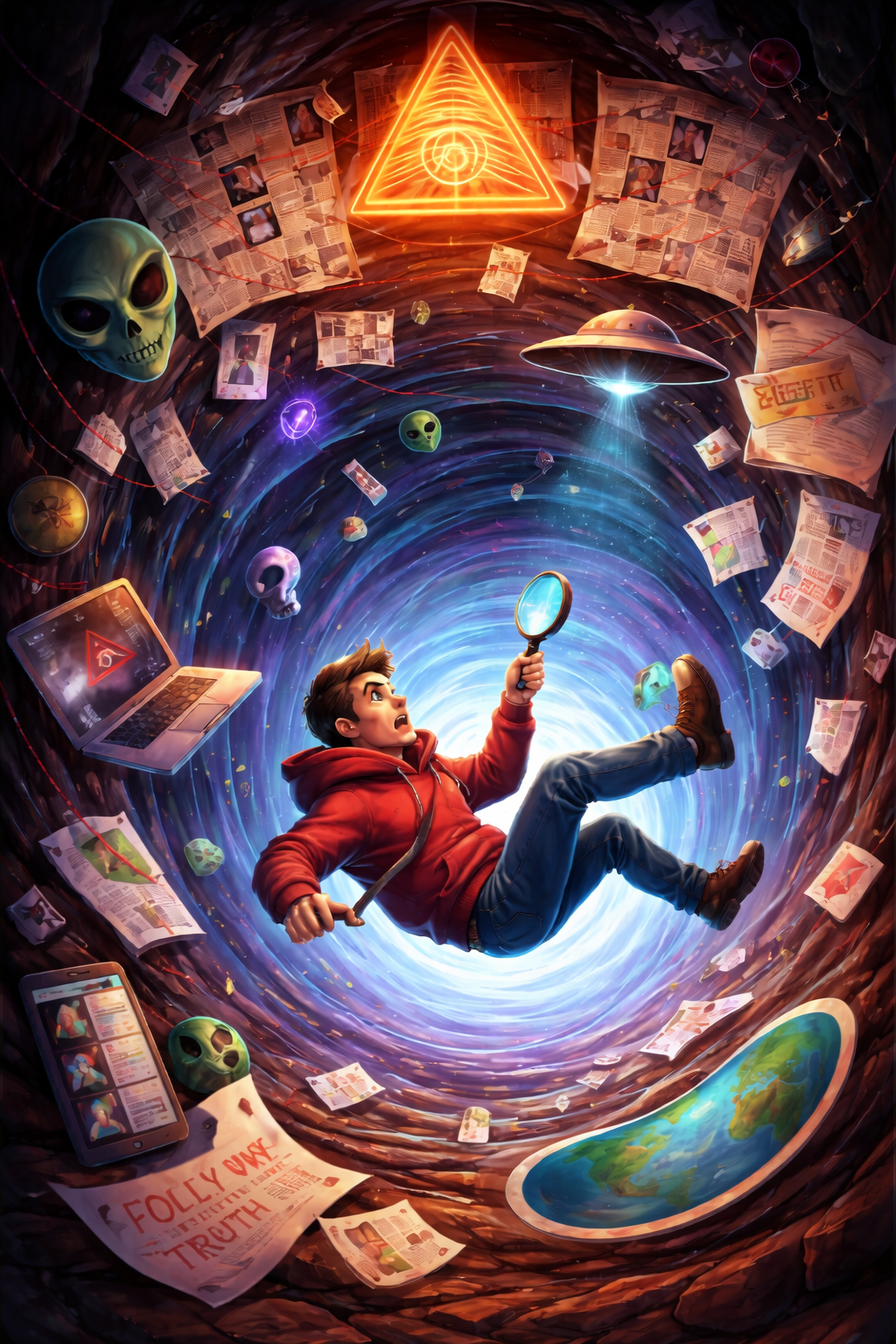
Why We Get Pulled In So Easily
There’s something oddly satisfying about feeling like you’ve uncovered something hidden. That’s exactly where conspiracy rabbit holes get their grip. At the core of it all is curiosity, but not the casual kind. This is the kind that whispers what if there’s more to the story?
As people scroll late at night or click just one more video, the brain starts rewarding that behavior. Dopamine kicks in every time a “new clue” shows up. It feels like progress, like solving a mystery. However, instead of reaching a clear answer, the path keeps stretching further. That’s what turns a simple question into a full-blown rabbit hole.
At the same time, people are wired to look for patterns. Even when none exist, the brain tries to connect dots. So when unrelated events pop up, it becomes tempting to tie them together into one big explanation. That explanation may not be accurate, but it feels meaningful, and that feeling is hard to shake.
The Need for Control in a Chaotic World
Life does not always make sense. Bad things happen, and sometimes there is no clear reason why. That lack of control can sit heavily, so the brain looks for ways to fix that feeling.
This is where conspiracy thinking steps in. Instead of randomness, there is suddenly a plan. Instead of chaos, there is intention. Even if that intention feels dark or unsettling, it still feels better than believing everything is completely out of control.
Because of that, conspiracy rabbit holes tend to grow during uncertain times. When the world feels shaky, people start searching harder for answers. The problem is, the deeper someone goes, the harder it becomes to separate what is real from what just feels convincing.
Confirmation Bias Keeps the Cycle Going
Once someone leans toward believing something, the brain starts filtering information. This is called confirmation bias, and it plays a huge role in how rabbit holes deepen.
Instead of looking at all sides, people begin to favor anything that supports what they already believe. Videos, articles, comments, and even random posts start to line up in a way that reinforces the idea. On the flip side, anything that challenges it gets ignored or dismissed.
Over time, this creates a loop. The more someone believes, the more they see “evidence.” The more evidence they see, the stronger the belief becomes. It feeds itself, and breaking out of that loop gets harder the longer it goes on.
The Internet Makes It Way Too Easy
Years ago, you had to actually go looking for fringe ideas. Now they find you. Algorithms are built to keep people engaged, so once someone shows interest in a topic, more of it gets pushed their way.
Watch one video, and suddenly there are ten more lined up. Click on an article, and your feed fills with similar content. Before long, it feels like everyone is talking about the same thing, even if it is just a curated bubble.
This constant exposure creates the illusion that the idea is more widely accepted than it really is. It also speeds up how quickly someone can fall deeper into a rabbit hole without even realizing it.
The Social Connection Factor
One thing people do not talk about enough is how conspiracy communities can feel welcoming. When someone finds others who believe the same thing, there is a sense of belonging that can be hard to walk away from.
Conversations feel validating. Ideas get reinforced. People start to feel like they are part of something bigger, like they are among the few who “see the truth.”
Walking away from that is not just about changing your mind. It can feel like losing a community. That emotional connection is one of the biggest reasons people stay locked into those beliefs longer than they probably would otherwise.
Related:The Psychology Behind Crimes of Passion
Why It Is So Hard to Climb Back Out
Getting pulled into a conspiracy rabbit hole is one thing. Climbing back out is something else entirely.
The deeper someone goes, the more time and energy they have invested. Admitting something might not be true can feel like admitting they were wrong the whole time, and nobody enjoys that feeling.
On top of that, leaving the belief often means stepping away from the community that came with it. That double hit makes it easier to stay in the rabbit hole than to question it.
In the end, it is not about intelligence or gullibility. It is about human psychology. Curiosity, fear, the need for control, and the desire to belong all play a part. Put all of that together, and it becomes a lot easier to understand why so many people get pulled in and why so many struggle to get back out.
Lisa Crow contributed to this article. She is a true crime junkie and lifestyle blogger based in Waco, Texas. Lisa is the Head of Content at Gigi’s Ramblings and Southern Bred True Crime Junkie. She spends her free time traveling when she can and making memories with her large family which consists of six children and sixteen grandchildren.