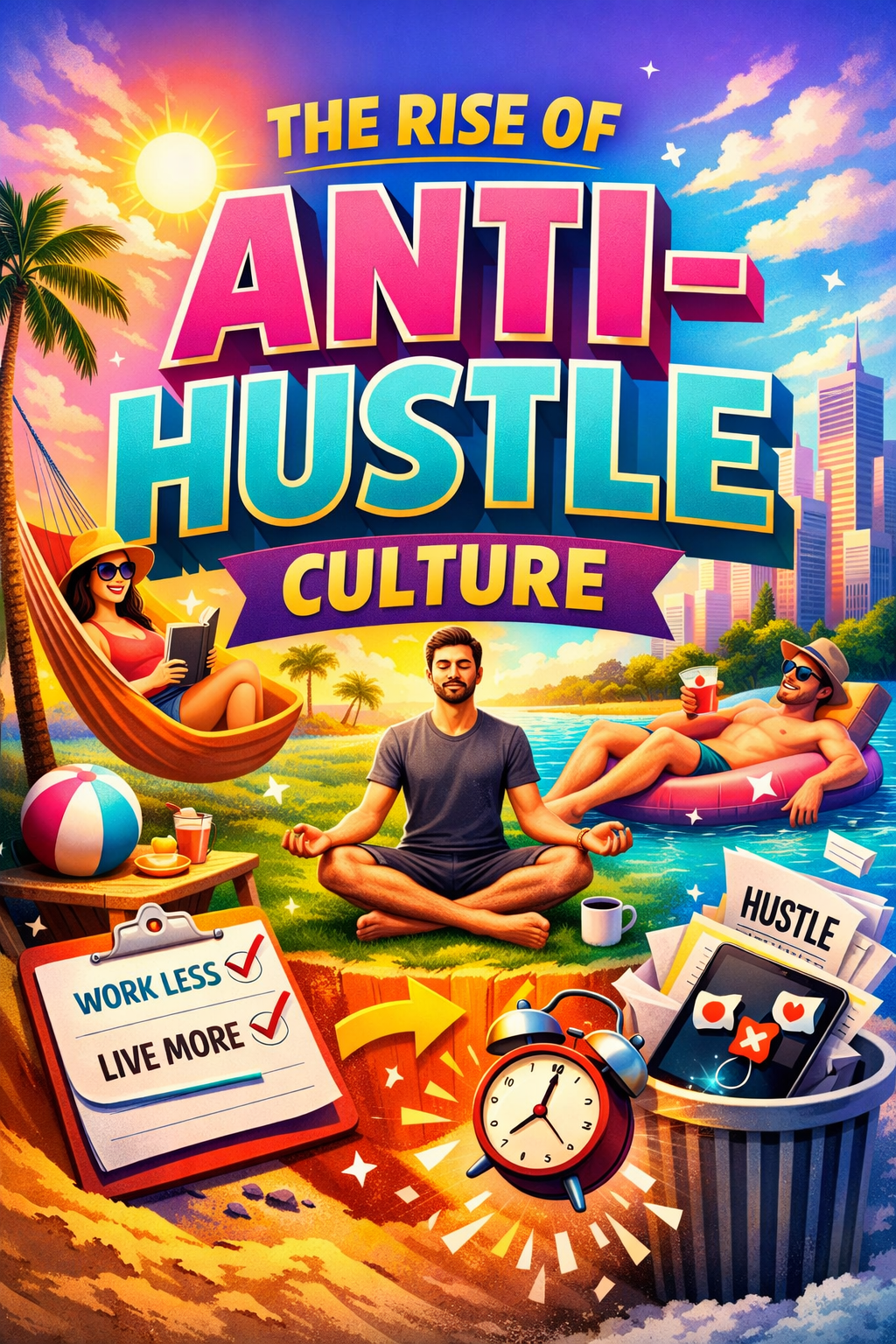
For years, hustle culture was sold as the only path to success. Wake up at 5 a.m. Grind while everyone else sleeps. Build multiple income streams. Never stop moving. If you were tired, you were lazy. If you rested, you were weak. However, something has shifted. More people are openly rejecting hustle culture and embracing what is now being called anti-hustle culture.
At its core, anti-hustle culture challenges the idea that your worth is tied to productivity. Instead of glorifying burnout, it prioritizes balance, boundaries, and actual well-being. That shift did not happen overnight. It has been building for years, especially as conversations about mental health, burnout, and work-life balance became impossible to ignore.
What Is Anti-Hustle Culture?
Anti-hustle culture is not about being lazy or unmotivated. That is a common misunderstanding. Instead, it questions the toxic productivity mindset that says you must constantly monetize every skill, turn every hobby into a side hustle, and treat rest like a reward you have to earn.
Rather than chasing endless productivity, people embracing slow living and balanced ambition are choosing to work smarter, not longer. They are setting clear work boundaries. They are logging off at reasonable hours. They are taking their PTO without guilt. Most importantly, they are redefining success on their own terms.
This movement gained traction after the pandemic forced many people to reevaluate their priorities. Suddenly, long commutes and 60-hour workweeks did not seem worth it. Time with family mattered more. Mental health mattered more. Even simple things like cooking at home or stepping outside for fresh air started to feel important again.
Why Burnout Sparked a Backlash
Burnout is not just feeling tired after a long week. It is chronic stress that leaves you emotionally drained, cynical, and disconnected from your work. According to workplace studies, burnout has been rising for years, especially among millennials and Gen Z. Social media only amplified the pressure. Every scroll brought another entrepreneur bragging about a six-figure launch or a 4 a.m. morning routine.
Eventually, people started asking a hard question. Is this sustainable?
For many, the answer was no. The constant push for more income, more output, and more visibility created anxiety instead of fulfillment. Even self-employment, which once felt like freedom, began to mirror the same grind mentality people were trying to escape. When your phone becomes your office and your office never closes, the hustle never really ends.
As a result, anti-hustle culture became a form of rebellion. It gave people permission to slow down without feeling like failures. It reminded them that productivity is not the same thing as purpose.
Social Media’s Role in the Shift
Ironically, the same platforms that fueled hustle culture are now fueling its decline. Content creators are openly discussing burnout, quiet quitting, and the importance of rest. Instead of glamorizing 18-hour workdays, they are sharing realistic routines that include sleep, boundaries, and downtime.
Moreover, transparency has replaced the highlight reel. People are admitting that constant grinding did not automatically bring happiness. Some even found that scaling back improved both their mental health and their income because they focused on sustainable growth instead of frantic expansion.
This does not mean ambition is dead. It simply means ambition is evolving. People still want financial security and meaningful work. They just do not want to sacrifice their health to get it.
Related: Reclaiming Boring Evenings: Why Doing Less Might Be the Reset You Need
Anti-Hustle Does Not Mean Anti-Success
One of the biggest myths about anti-hustle culture is that it promotes mediocrity. In reality, it promotes intention. There is a difference between working hard toward a goal and working yourself into the ground to prove something.
Balanced ambition allows room for rest and growth at the same time. It encourages strategic work instead of constant busy work. It values deep focus over endless multitasking. As a result, many people find they are actually more productive when they stop trying to be productive every waking hour.
Furthermore, redefining success often leads to better decisions. Instead of chasing every opportunity, people choose the ones that align with their long-term goals. Instead of saying yes to everything, they protect their time. That shift alone can dramatically improve work-life balance.
Why Anti-Hustle Culture Is Here to Stay
Trends come and go, but the conversation around mental health and burnout is not fading. Employers are paying attention. Flexible work schedules, remote options, and four-day workweek trials are becoming more common. Even corporate environments are recognizing that burned-out employees are not high-performing employees.
At the same time, individuals are setting firmer boundaries. They are turning off notifications after hours. They are separating their identity from their job titles. They are choosing peace over constant pressure.
The rise of anti-hustle culture reflects a deeper cultural change. People are no longer impressed by exhaustion as a badge of honor. They want sustainability. They want fulfillment. They want a life that includes work, not one consumed by it.
In the end, rejecting hustle culture does not mean you lack drive. It means you are done equating your value with your output. Success can still be pursued. Goals can still be achieved. However, the path does not have to include burnout, anxiety, and constant comparison.
Maybe the real flex now is building a life that feels good behind the scenes, not just one that looks impressive online.
Lisa Crow contributed to this article. She is a true crime junkie and lifestyle blogger based in Waco, Texas. Lisa is the Head of Content at Gigi’s Ramblings and Southern Bred True Crime Junkie. She spends her free time traveling when she can and making memories with her large family which consists of six children and fifteen grandchildren.