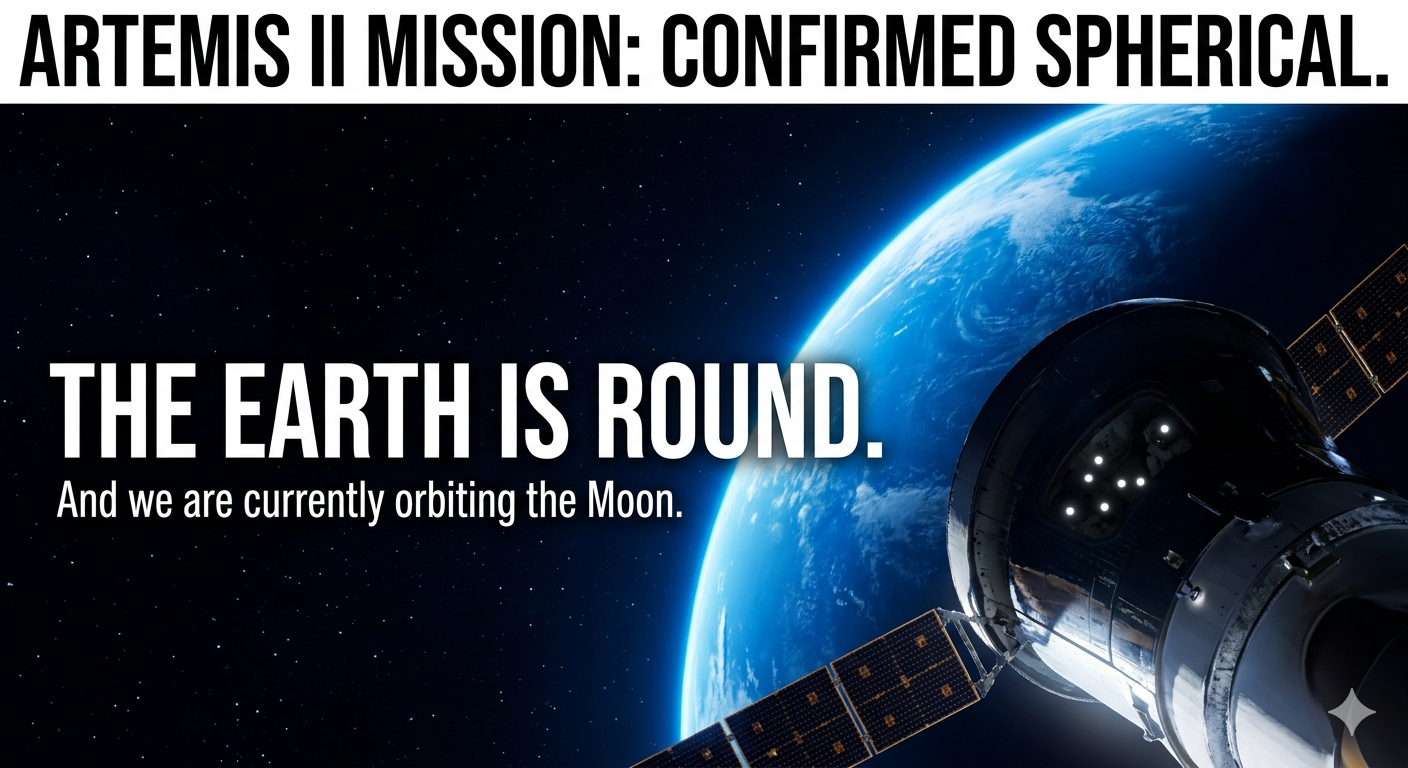
A cinematic, high-resolution view from space showing the Orion spacecraft in the foreground with its solar panels extended. In the background, the vibrant blue curvature of the Earth glows against the black void of space, featuring bold text that reads "ARTEMIS II MISSION: CONFIRMED SPHERICAL. THE EARTH IS ROUND."

The world is currently watching as four human beings hurtle through the vacuum of space toward the lunar far side. This isn’t a sci-fi movie or a CGI render from a studio. On April 1, 2026, the Artemis II mission officially launched, marking the first time in over five decades that humans have ventured beyond low Earth orbit. For anyone who appreciates human achievement, this is a massive milestone. We are testing the Orion spacecraft and the Space Launch System (SLS) to ensure that when we finally land on the lunar surface again, we are there to stay.

My Take on the Moon Landing Denial and Flat Earth Nonsense

While I’m sitting here in awe of the engineering and the sheer bravery of these astronauts, I’ve had the misfortune of scrolling through some truly toxic comment sections. It blows my mind the crap these people think. I have found myself in digital shouting matches with flat-earthers lately, and the level of “logic” they use is exhausting.

I want to make my personal beliefs very clear: I absolutely believe we have already been to the moon. The Apollo missions were a triumph of human grit. To suggest that we faked it in the 60s and are somehow still faking it now with 2026 technology is beyond ridiculous. Yet, these tin foil hat morons continue to flood the internet with theories that make my head spin.

Debunking the Crazy Theories from the Tin Foil Hat Crowd

It is hard to stay casual when you read someone claiming that the moon is a hologram or that the Earth is a flat disc protected by an ice wall. Some of these crazy theories are honestly hilarious if they weren’t so sad. I’ve seen people argue that gravity isn’t a real force and that we stay on the ground because of “density.” I’ve seen others claim that the photos of the curved horizon are just “fisheye lens propaganda.”

The reality is that physics doesn’t care about your conspiracy theory. We have satellites, GPS, and now a crew of four people currently looking at the entire sphere of the Earth from thousands of miles away. If the Earth were flat, the logistics of a lunar slingshot maneuver would be mathematically impossible. The fact that we can predict exactly where the Orion capsule will be at any given second is proof enough that the globe is real and the science is sound.

Related: The Psychology Behind Conspiracy Rabbit Holes

The Real Significance of Returning to Deep Space

This mission is about more than just sticking it to the skeptics. Artemis II is the ultimate stress test. The crew is traveling farther into the cosmos than any human in history, looping around the Moon to test life support systems in a high-radiation environment. This is the precursor to Artemis III, which will actually put boots back on the ground.

We are watching history happen in real time. While the trolls stay buried in their forums trying to prove the sun is a flashlight, the rest of us are looking up at the stars and seeing the next chapter of human evolution. We are going back to the Moon, and eventually, we are going to Mars. It’s time to leave the “flat” talk in the dark ages where it belongs.

Lisa Crow contributed to this article. She is a true crime junkie and lifestyle blogger based in Waco, Texas. Lisa is the Head of Content at Gigi’s Ramblings and Southern Bred True Crime Junkie. She spends her free time traveling when she can and making memories with her large family which consists of six children and sixteen grandchildren.
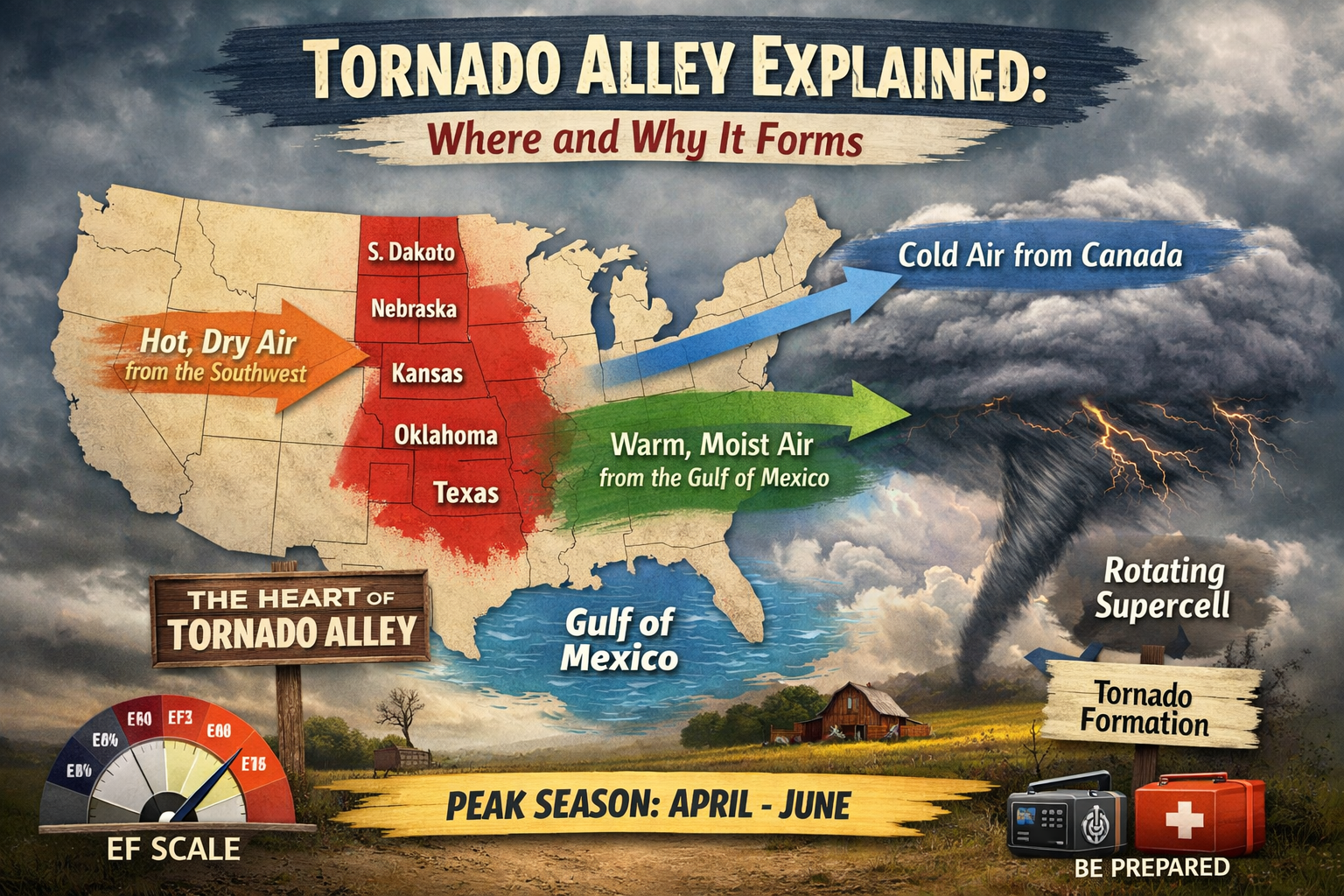
A dramatic infographic titled “Tornado Alley Explained: Where and Why It Forms” shows a map of the central United States highlighting Texas, Oklahoma, Kansas, Nebraska, and South Dakota as the core of Tornado Alley.

What Is Tornado Alley?

Tornado Alley is a loosely defined region in the central United States where tornadoes occur more frequently than in other areas. While there is no official boundary, it is generally accepted to include parts of Texas, Oklahoma, Kansas, Nebraska, and South Dakota. Because of its unique weather patterns, this region experiences a higher number of tornadoes each year compared to most other places on Earth.

The term itself is not a scientific designation, but it is widely used in weather discussions, media reports, and everyday conversations. Over time, Tornado Alley has become synonymous with severe spring and early summer storms.

Why Tornadoes Form in This Region

Tornado Alley exists due to a combination of geography and atmospheric conditions. Warm, moist air from the Gulf of Mexico moves northward, while cold, dry air travels south from Canada. At the same time, hot, dry air often pushes in from the desert regions of the southwestern United States.

When these air masses collide, instability in the atmosphere is created. As a result, powerful thunderstorms can develop. In some cases, these storms begin to rotate, forming what meteorologists call supercells. These rotating storms are the primary source of the most intense and destructive tornadoes.

Related: Is Spring Fever Real? A Look at the Science & Myth

Peak Tornado Season

Tornado activity in Tornado Alley is most common during the spring and early summer months. Typically, the peak season runs from April through June. During this time, temperature contrasts between air masses are strongest, increasing the likelihood of severe weather.

However, tornadoes can still occur outside of this window. States like Texas may begin seeing tornado activity as early as March, while northern areas might experience storms later into the summer.

How Strong Are Tornadoes?

Tornado strength is measured using the Enhanced Fujita Scale, often referred to as the EF Scale. This system classifies tornadoes based on estimated wind speeds and the damage they cause. Ratings range from EF0, which includes weaker storms, to EF5, which represents the most violent and destructive tornadoes.

An EF5 tornado can produce winds exceeding 200 miles per hour, capable of leveling homes and causing catastrophic damage. While these extreme events are rare, they are a major reason Tornado Alley is closely monitored by meteorologists.

States Most Affected

Although Tornado Alley covers multiple states, some areas experience more frequent tornado activity than others. Texas consistently leads the nation in the total number of tornadoes each year due to its large size and varied climate.

Oklahoma and Kansas are also well known for intense tornado outbreaks. Because of their central location within Tornado Alley, these states often experience the strongest storms during peak season.

Tornado Safety and Preparedness

Because tornadoes can develop quickly, preparation is essential. Weather alerts issued by organizations like the National Weather Service play a critical role in keeping people safe.

Having a plan in place can make a significant difference. Safe locations such as basements or interior rooms without windows offer the best protection during a tornado. Additionally, keeping emergency supplies on hand ensures you are ready when severe weather strikes.

Interesting Facts About Tornado Alley

Tornado Alley is home to some of the most powerful tornadoes ever recorded. The Tri-State Tornado remains one of the deadliest in U.S. history, traveling across Missouri, Illinois, and Indiana.

Another interesting detail is that Tornado Alley has shifted slightly over time. Some studies suggest that tornado activity has expanded eastward, bringing more frequent storms to states outside the traditional region.

Despite the risks, millions of people live in Tornado Alley and have adapted to its unpredictable weather patterns. With improved forecasting and awareness, communities are better prepared than ever before.

Why Tornado Alley Still Matters Today

Understanding Tornado Alley helps people stay informed and prepared. As weather patterns continue to evolve, awareness of severe storm risks becomes increasingly important.

Whether you live in the region or are just curious about extreme weather, Tornado Alley remains one of the most fascinating and powerful natural phenomena in the United States.

Lisa Crow contributed to this article. She is a true crime junkie and lifestyle blogger based in Waco, Texas. Lisa is the Head of Content at Gigi’s Ramblings and Southern Bred True Crime Junkie. She spends her free time traveling when she can and making memories with her large family which consists of six children and sixteen grandchildren.

Woman stargazing in a cozy backyard at night with a telescope, glowing lanterns, string lights, and a bright full moon surrounded by stars.

There is something oddly peaceful about standing outside at night and staring up at the sky. The noise of the day fades out, the air feels a little cooler, and suddenly the universe seems a whole lot bigger than the to-do list waiting inside the house. Truthfully, I have never been the kind of person who can name every constellation or quote scientific facts about distant galaxies. I’m such a look at the moon and stars kinda girl, and that is exactly what makes backyard astronomy so perfect for beginners.

The good news is that backyard astronomy does not require expensive equipment or a science degree. With a little curiosity and a few simple tools, the night sky can be enjoyed from your own yard.

Why Backyard Astronomy Is Perfect for Beginners

One of the best parts about backyard astronomy is how approachable it is. Unlike many hobbies, a complicated setup is not required to get started. In fact, the sky does most of the work.

First of all, the night sky is constantly changing. Because the Earth rotates, different stars and constellations appear throughout the evening. Additionally, the moon moves through phases each month, which means there is always something new to look at.

As a result, even beginners can step outside and experience something interesting without needing to know much beforehand. Curiosity is really the only requirement.

Start With Your Eyes First

Before a telescope is even considered, the most useful tool is already available: your eyes.

When the lights inside the house are turned off and a few minutes are spent letting the eyes adjust to the dark, far more stars begin to appear. At first, only the brightest stars might be noticed, but gradually entire patterns become visible.

For beginners, it is often recommended that the moon be observed first. Its craters, shadows, and surface textures can easily be seen with the naked eye. On clear nights, the moon almost feels close enough to touch.

Because of this, many people fall in love with backyard astronomy simply by watching the moon change shape throughout the month.

Related: Let’s Travel to Marfa, Texas

Helpful Apps and Simple Tools

Although backyard astronomy can start with nothing more than curiosity, a few tools can make the experience even better.

For example, stargazing apps can identify stars, constellations, and planets just by pointing a phone toward the sky. Apps like SkyView and Star Walk 2 have made it incredibly easy for beginners to figure out what they are looking at.

In addition, a basic pair of binoculars can reveal far more detail than the naked eye alone. Star clusters and bright planets suddenly become clearer, which makes the sky feel even more alive.

Later on, if the hobby really sticks, a beginner telescope can always be added. However, many backyard astronomers happily spend years exploring the sky with nothing more than binoculars.

Easy Things to Look for in the Night Sky

When someone first starts backyard astronomy, it can feel overwhelming because there is so much up there. Fortunately, a few easy targets can make the first few nights more exciting.

The moon is always the most obvious place to start. After that, bright planets often become visible throughout the year. For example, Jupiter and Saturn are frequently spotted and can even be seen with binoculars under the right conditions.

Constellations are another great starting point. The famous Orion constellation is one of the easiest to recognize thanks to its distinctive belt of three stars.

Once these simple objects are found, the sky suddenly feels far less intimidating.

Making Backyard Stargazing a Relaxing Routine

Backyard astronomy does not have to be treated like a serious scientific activity. In fact, it can easily become a peaceful nightly routine.

A chair can be pulled into the yard, a blanket can be wrapped around the shoulders, and a warm drink can be brought outside. After that, the sky can simply be enjoyed without any pressure to identify every single star.

Over time, familiar constellations begin to feel like old friends. Planets appear in new spots, and the moon quietly cycles through its phases again and again.

That is really the magic of backyard astronomy. The universe is always putting on a show, and the best seat in the house might just be the backyard.

And honestly, for those of us who are just look at the moon and stars kinda girls, that is more than enough. ✨

Lisa Crow contributed to this article. She is a true crime junkie and lifestyle blogger based in Waco, Texas. Lisa is the Head of Content at Gigi’s Ramblings and Southern Bred True Crime Junkie. She spends her free time traveling when she can and making memories with her large family which consists of six children and sixteen grandchildren.