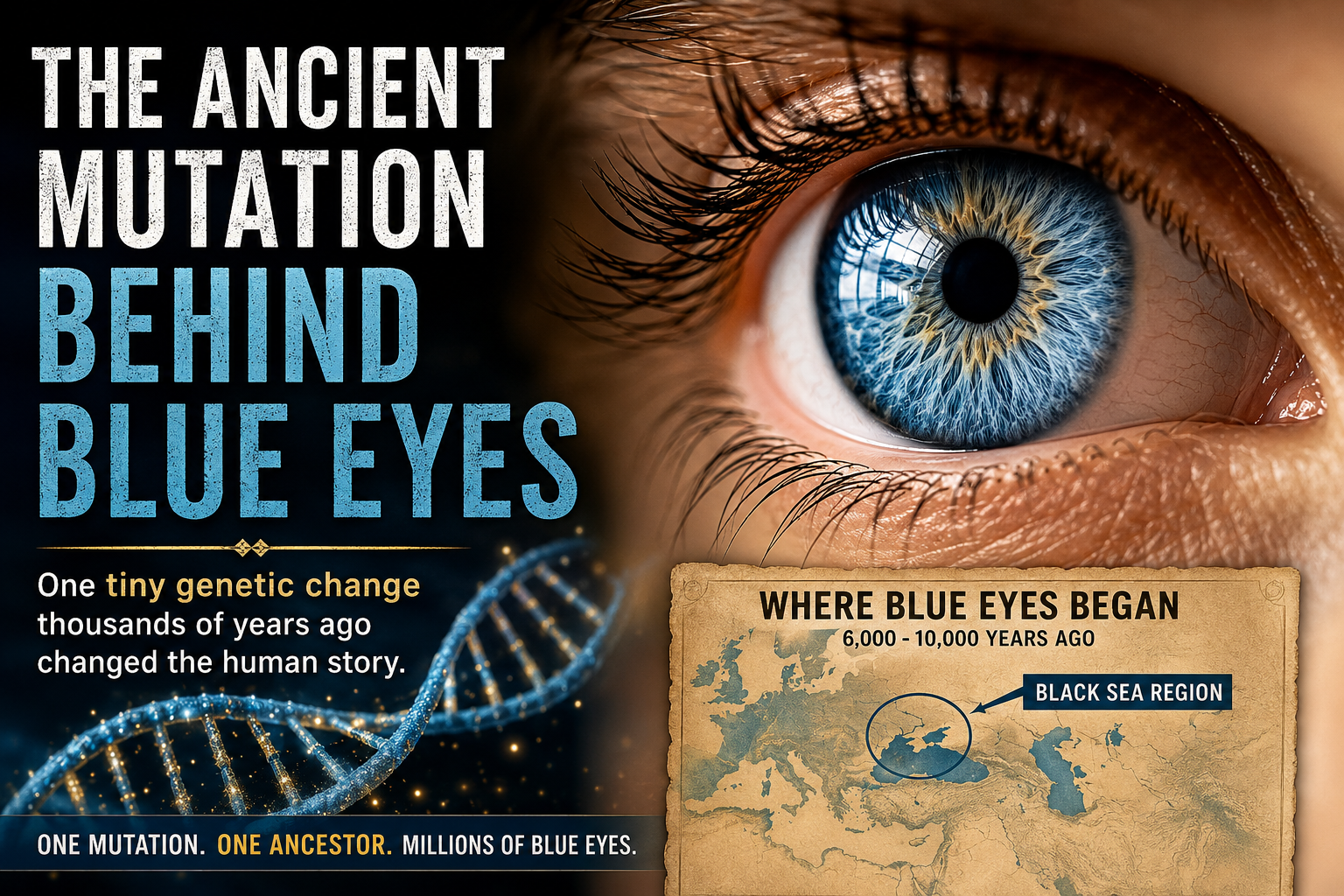
Blue eyes are one of the most recognizable human traits, but they are also one of the newest in human history.
For most of human existence, scientists believe nearly everyone had brown eyes. Brown eyes contain more melanin, the pigment responsible for color in the iris, skin, and hair. At some point thousands of years ago, however, a small genetic change appeared and created something completely new. That one change spread across generations and eventually gave rise to millions of blue-eyed people living today.
What makes the story even more interesting is that researchers believe most blue-eyed people share the same original genetic source.
When And Where Blue Eyes First Appeared
Current research suggests blue eyes originated somewhere between 6,000 and 10,000 years ago. Scientists believe the mutation likely appeared in a population living near the Black Sea region or surrounding parts of Europe during the Neolithic period.
The change involved genes that influence melanin production, particularly a regulatory change connected to the OCA2 and HERC2 genes. Instead of creating blue pigment, the mutation reduced the amount of brown pigment produced in the iris.
That means blue eyes are not actually blue in the same way paint or fabric is blue.
The lower amount of melanin changes the way light scatters through the iris, creating the appearance of blue.
Before this mutation appeared, researchers believe brown eyes were likely the standard human eye color.
The Idea That Blue-Eyed People Share One Ancient Ancestor
One of the discoveries that made headlines was the finding that most blue-eyed people appear to carry the same genetic signature connected to this mutation.
That does not mean every blue-eyed person is closely related in the way people often imagine. It means the genetic change itself likely happened once and spread through thousands of years of migration, families, and population growth.
In simple terms, if you have blue eyes today, researchers think your eye color traces back to one ancient group of people who carried this mutation and passed it forward generation after generation.
That tiny change eventually spread across continents and became one of the most recognizable inherited traits in the world.
Why Blue Eyes Still Show Up In Unexpected Families
Eye color inheritance turns out to be far more complicated than the old classroom chart that says brown dominates blue.
Multiple genes influence eye color, which explains why families often end up with combinations that surprise everyone.
In my own family, one parent has brown eyes and one has blue eyes, yet 2 out of the 3 children inherited blue eyes. Looking at the next generation makes it even more interesting because 5 of my 6 children have light eyes ranging from deep blue to hazel.
That sounds unusual until you understand that people can carry hidden combinations of eye color genes for generations before certain traits appear more strongly again.
This is also why siblings can end up looking dramatically different from one another even though they share the same parents.
Are Blue Eyes Becoming Less Common?
Blue eyes are still common in parts of Northern and Eastern Europe, but globally they are relatively uncommon today.
One reason researchers believe lighter eye colors may slowly become less concentrated in certain populations is that people now have children across a much wider mix of ancestral backgrounds than in previous centuries. Human populations are more connected than at any point in history, which increases genetic diversity overall.
Since darker eye colors are generally more common worldwide and involve higher melanin production, blue eyes may appear less frequently in some regions over time.
That does not mean blue eyes are disappearing. It simply means that populations change and traits become more mixed as generations continue.
Other Interesting Facts About Blue Eyes
Blue eyes make up only a small percentage of the world population.
People with blue eyes may be more sensitive to bright sunlight because lighter irises contain less pigment.
Babies born with blue eyes do not always stay blue. Eye color can continue changing during infancy as melanin production develops.
Hazel eyes are one of the hardest eye colors to predict genetically because they involve several genes interacting together.
And despite what people assume, two blue-eyed parents can occasionally have children with eye colors that do not match expectations because inheritance is more complex than simple dominant and recessive rules.
For something caused by a tiny genetic change thousands of years ago, blue eyes ended up becoming one of the most noticeable examples of how human genetics continues to shape families today.
Lisa Crow contributed to this article. She is a true crime junkie and lifestyle blogger based in Waco, Texas. Lisa is the Head of Content at Gigi’s Ramblings and Southern Bred True Crime Junkie. She spends her free time traveling when she can and making memories with her large family which consists of six children and sixteen grandchildren.