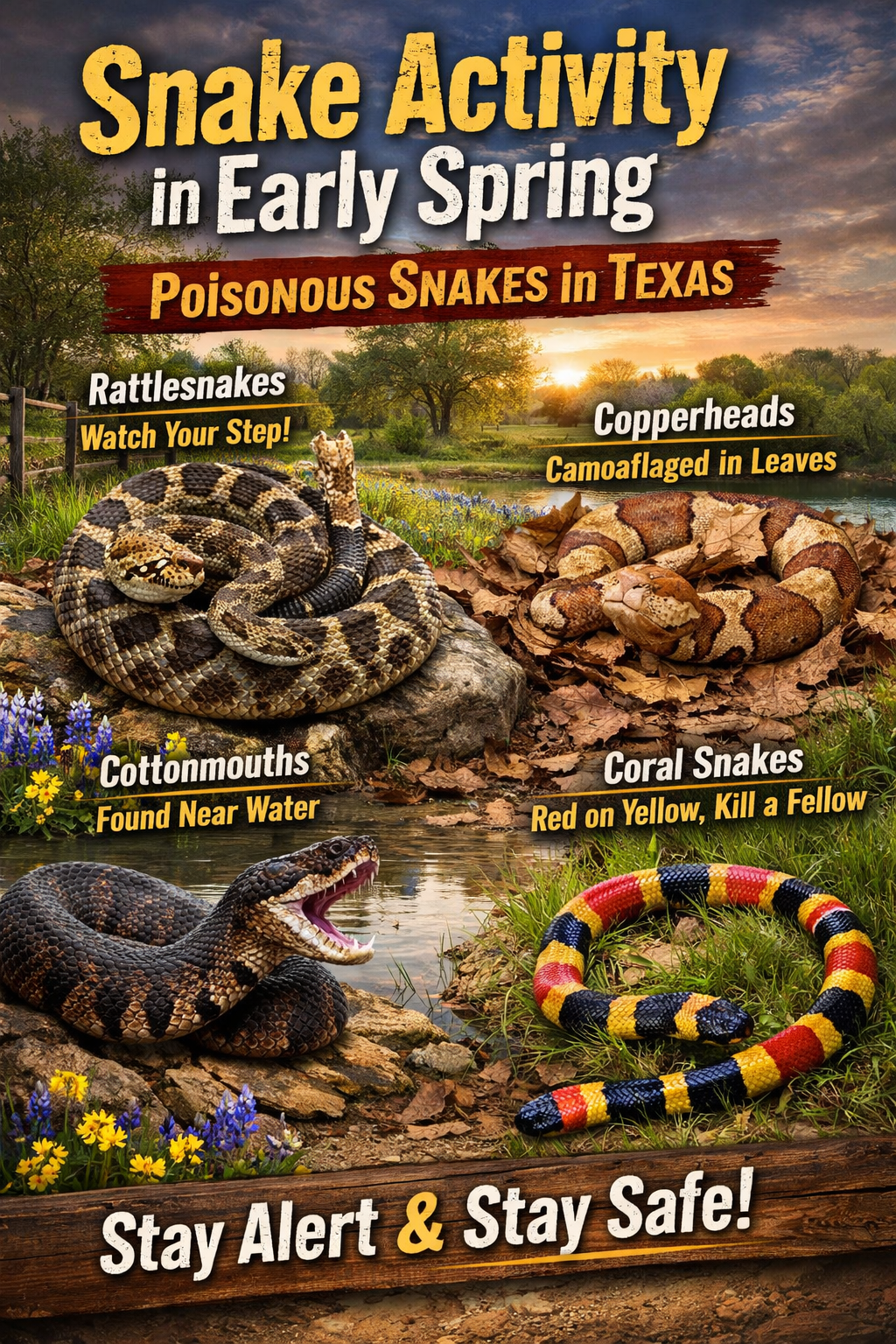
Early spring checks all the boxes for snakes:
- Warmer ground temps help them regulate body heat
- Rodents and frogs become more active, so food increases
- Mating season begins for many species
- Rain pushes them out of burrows and low areas
You’ll especially see them:
- Around wood piles and debris
- Near water sources
- Along fence lines
- On warm roads in the evening
- In tall grass or brush
Most bites happen when someone accidentally steps near one or tries to move it.
Related: Beekeeping in Early Spring: What Every Beginner Should Know
Venomous Snakes Native to Texas
Texas has four major venomous groups, but several species inside those groups.
Rattlesnakes (Most Common)
Texas has more rattlesnake species than any other state. The most commonly encountered include:
- Western Diamondback Rattlesnake
- Timber Rattlesnake
- Prairie Rattlesnake
- Western Massasauga
Early spring behavior:
- Often sunning on rocks or pavement
- Slow-moving in the mornings
- More defensive since they’re still sluggish
- Common in rural areas and neighborhoods near fields
These are responsible for most venomous bites in Texas.
Copperheads
- Southern Copperhead
- Broad-banded Copperhead
Early spring behavior:
- Excellent camouflage in leaves
- Often freeze instead of fleeing
- Common in wooded yards and brush
- Frequently stepped on accidentally
Good news. Their venom is milder than that of rattlesnakes, but still requires medical care.
Cottonmouths (Water Moccasins)
- Cottonmouth
Early spring behavior:
- Found near ponds, creeks, and lakes
- Often basking on logs or banks
- Stand their ground more than other snakes
- Active on warm afternoons
Despite their reputation, they usually only strike if cornered.
Coral Snakes
- Texas Coral Snake
Early spring behavior:
- Secretive and rarely seen
- Usually under leaves, logs, or debris
- Most active after rain
- Small but highly venomous
Easy rhyme people remember:
Red on yellow, kill a fellow
Red on black, friend of Jack
Still, the best rule is never to handle any snake.
When Activity Peaks
You’ll notice the biggest increase:
- Late March through May
- After warm rainy days
- At dusk and early evening
- When temps hit 70 to 85°F
That’s prime movement weather.
How to Avoid Snake Encounters
Simple steps make a huge difference:
- Keep the grass cut short
- Remove wood and debris piles
- Watch where you step outdoors
- Use a flashlight at night
- Wear boots in tall grass
- Don’t reach into holes or under boards
Most snakes want nothing to do with people.
Important Note
Even though people say “poisonous,” these are technically venomous. Poison harms when touched or eaten. Venom is injected through a bite. Either way, you definitely don’t want either one. 😅
Early spring is just their wake-up season. Seeing more snakes doesn’t mean there are more than usual. They’re just out and about again.
Lisa Crow contributed to this article. She is a true crime junkie and lifestyle blogger based in Waco, Texas. Lisa is the Head of Content at Gigi’s Ramblings and Southern Bred True Crime Junkie. She spends her free time traveling when she can and making memories with her large family which consists of six children and sixteen grandchildren.