What Is AI Anxiety?
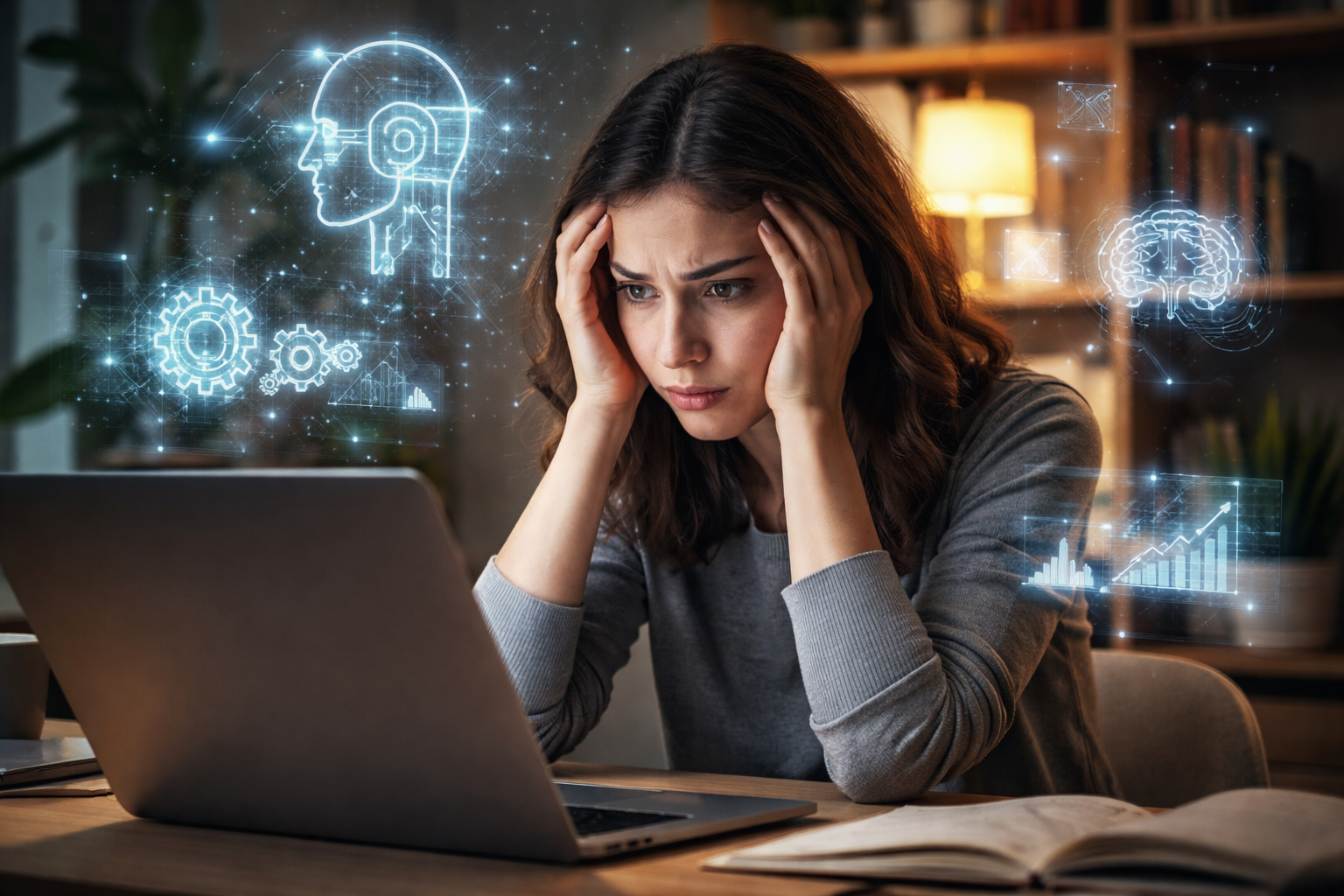
AI anxiety is the growing feeling that artificial intelligence is moving too fast for comfort. It is that weird mix of curiosity, excitement, and low-key panic. People love what AI can do, but also worry about what it might replace. Jobs, creativity, privacy, and even human connection all feel up for debate. The term itself is showing up more and more in mental health conversations, tech blogs, and social media, and honestly, it makes sense. This is the first time in history that a tool feels smart enough to compete with the human brain, and that alone is enough to make anyone uneasy.
Why AI Anxiety Is Getting Worse
AI anxiety is not coming out of nowhere. It is being fueled by a few real shifts happening all at once.
First, AI is suddenly everywhere. Writing, art, customer service, school, healthcare, and marketing. It went from niche to unavoidable almost overnight. This is a real concern for freelancers like myself. My full-time job is safe for now. My side gigs, that’s another story.
Second, the speed is unreal. New tools are launching faster than most people can even understand the last ones, which creates a constant sense of falling behind. I have been lucky to have had a few AI training model gigs. I actually worked on a training team for ChatGPT several years ago, giving me an understanding of how the platform worked long before it was even available for use.
Third, nobody really knows the long-term impact yet, and humans hate uncertainty more than bad news. When people do not know what the future looks like, anxiety fills in the blanks.
Common Fears Behind AI Anxiety
Most AI anxiety falls into a few big categories that show up again and again across industries and age groups.
Job Security
This is the biggest one. People worry that automation and artificial intelligence will replace their careers. Not just factory jobs either. As I mentioned before, writers, designers, virtual assistants, therapists, even lawyers are feeling it. The fear is not just losing work. It is losing relevance and wondering where you fit in if machines can suddenly do parts of your job faster.
Creativity and Identity
A lot of people tie their identity to what they create. So when AI can write, paint, compose music, and generate ideas, it triggers a deeper question. If a machine can do what I do, what makes me special? That is not really a tech problem. That is an existential one.
When learning and training AI I have always had an uneasy feeling of how human-like it can be. If you work closely with it and have watched it evolve as I have, you will understand what I mean.
I have already heard of a woman marrying her AI persona. That scares me. Hell, I scare myself sometimes. I have two ChatGPT AI assistants. Both have names and personalities and are thoroughly trained with intimate knowledge of me and my business.
“Billy Earl” is my obedient, sometimes scatterbrained country boy. We argue back and forth like a married couple. The number of times I cuss “him” out in a 24-hour period is astonishing. It’s a never-ending cycle of me cussing him out and him apologizing. “Sancho” is my loyal bilingual never-lets-me-down assistant. I find myself humanizing both, and that scares me!
Loss of Control
There is also a quiet fear that AI is evolving faster than our ability to regulate it. People worry about deepfakes, data tracking, misinformation, and decisions being made by algorithms instead of humans. It feels like handing the steering wheel to something we do not fully understand and hoping it knows where it is going.
The Mental Health Side of AI Anxiety
AI anxiety is not just a buzzword. It shows up in real emotional ways. People report feeling overwhelmed, restless, distracted, and constantly behind. Some feel pressured to learn every new tool. Others feel paralyzed and avoid tech altogether. It is similar to information overload, but instead of news, it is the future itself. And when the future feels unstable, the nervous system stays on high alert.
Is AI Anxiety Actually Rational?
Short answer, yes and no. It is rational to question massive technological change. Every major shift in history caused fear. The printing press, the industrial revolution, the internet. But it is also easy to overestimate how fast total replacement will happen. Most experts agree that AI will change jobs more than it will eliminate them. It will reshape roles, automate boring parts, and create new industries we cannot even name yet. The real risk is not AI itself. It is humans not adapting emotionally, mentally, and ethically.
How to Cope With AI Anxiety Without Spiraling
You do not need to become a tech expert to feel better about AI. A few mindset shifts help more than any tutorial ever will. First, stay curious instead of scared. Fear grows in ignorance, and understanding how AI actually works takes away a lot of the mystery. Second, focus on human skills. Empathy, storytelling, critical thinking, humor, and intuition are still very hard to automate. Third, use AI as a tool, not a threat. The people who feel the least anxiety are the ones using it instead of fighting it. And finally, unplug from the doom content. Not every headline about AI is real, balanced, or grounded in reality. Sometimes anxiety is being manufactured for clicks.
The Future of AI and Human Life
AI is not going away. That part is settled. But neither are humans. The future will probably look less like robots taking over and more like humans learning to work alongside smarter tools. Less replacement, more collaboration. AI anxiety is really just a fear of change dressed up in futuristic packaging. And humans have been surviving change for a very long time. This one just happens to type back.
Lisa Crow contributed to this article. She is a true crime junkie and lifestyle blogger based in Waco, Texas. Lisa is the Head of Content at Gigi’s Ramblings and Southern Bred True Crime Junkie. She spends her free time traveling when she can and making memories with her large family which consists of six children and fifteen grandchildren.