What Is Tornado Alley?
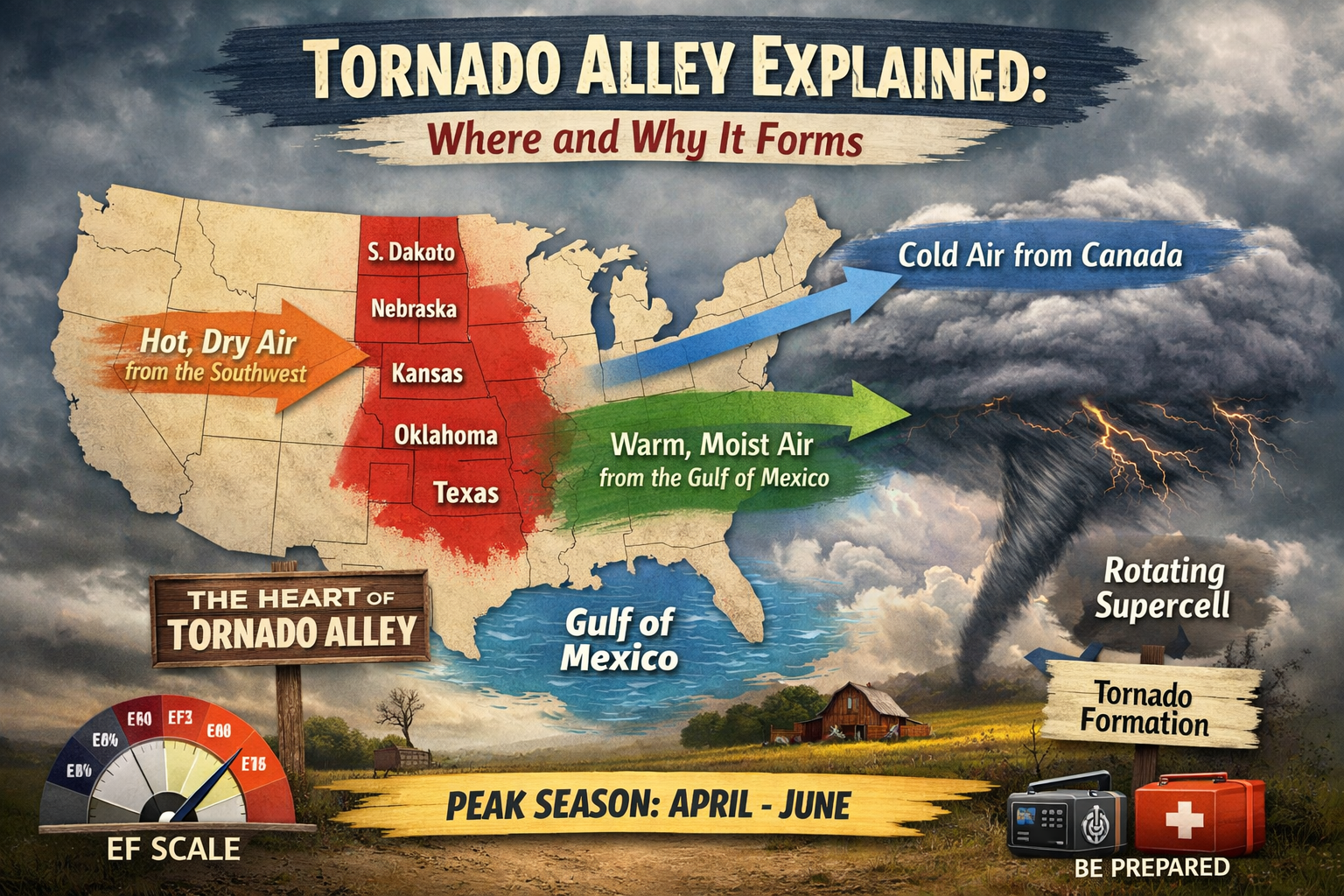
Tornado Alley is a loosely defined region in the central United States where tornadoes occur more frequently than in other areas. While there is no official boundary, it is generally accepted to include parts of Texas, Oklahoma, Kansas, Nebraska, and South Dakota. Because of its unique weather patterns, this region experiences a higher number of tornadoes each year compared to most other places on Earth.
The term itself is not a scientific designation, but it is widely used in weather discussions, media reports, and everyday conversations. Over time, Tornado Alley has become synonymous with severe spring and early summer storms.
Why Tornadoes Form in This Region
Tornado Alley exists due to a combination of geography and atmospheric conditions. Warm, moist air from the Gulf of Mexico moves northward, while cold, dry air travels south from Canada. At the same time, hot, dry air often pushes in from the desert regions of the southwestern United States.
When these air masses collide, instability in the atmosphere is created. As a result, powerful thunderstorms can develop. In some cases, these storms begin to rotate, forming what meteorologists call supercells. These rotating storms are the primary source of the most intense and destructive tornadoes.
Related: Is Spring Fever Real? A Look at the Science & Myth
Peak Tornado Season
Tornado activity in Tornado Alley is most common during the spring and early summer months. Typically, the peak season runs from April through June. During this time, temperature contrasts between air masses are strongest, increasing the likelihood of severe weather.
However, tornadoes can still occur outside of this window. States like Texas may begin seeing tornado activity as early as March, while northern areas might experience storms later into the summer.
How Strong Are Tornadoes?
Tornado strength is measured using the Enhanced Fujita Scale, often referred to as the EF Scale. This system classifies tornadoes based on estimated wind speeds and the damage they cause. Ratings range from EF0, which includes weaker storms, to EF5, which represents the most violent and destructive tornadoes.
An EF5 tornado can produce winds exceeding 200 miles per hour, capable of leveling homes and causing catastrophic damage. While these extreme events are rare, they are a major reason Tornado Alley is closely monitored by meteorologists.
States Most Affected
Although Tornado Alley covers multiple states, some areas experience more frequent tornado activity than others. Texas consistently leads the nation in the total number of tornadoes each year due to its large size and varied climate.
Oklahoma and Kansas are also well known for intense tornado outbreaks. Because of their central location within Tornado Alley, these states often experience the strongest storms during peak season.
Tornado Safety and Preparedness
Because tornadoes can develop quickly, preparation is essential. Weather alerts issued by organizations like the National Weather Service play a critical role in keeping people safe.
Having a plan in place can make a significant difference. Safe locations such as basements or interior rooms without windows offer the best protection during a tornado. Additionally, keeping emergency supplies on hand ensures you are ready when severe weather strikes.
Interesting Facts About Tornado Alley
Tornado Alley is home to some of the most powerful tornadoes ever recorded. The Tri-State Tornado remains one of the deadliest in U.S. history, traveling across Missouri, Illinois, and Indiana.
Another interesting detail is that Tornado Alley has shifted slightly over time. Some studies suggest that tornado activity has expanded eastward, bringing more frequent storms to states outside the traditional region.
Despite the risks, millions of people live in Tornado Alley and have adapted to its unpredictable weather patterns. With improved forecasting and awareness, communities are better prepared than ever before.
Why Tornado Alley Still Matters Today
Understanding Tornado Alley helps people stay informed and prepared. As weather patterns continue to evolve, awareness of severe storm risks becomes increasingly important.
Whether you live in the region or are just curious about extreme weather, Tornado Alley remains one of the most fascinating and powerful natural phenomena in the United States.
Lisa Crow contributed to this article. She is a true crime junkie and lifestyle blogger based in Waco, Texas. Lisa is the Head of Content at Gigi’s Ramblings and Southern Bred True Crime Junkie. She spends her free time traveling when she can and making memories with her large family which consists of six children and sixteen grandchildren.